Productivity●Mid
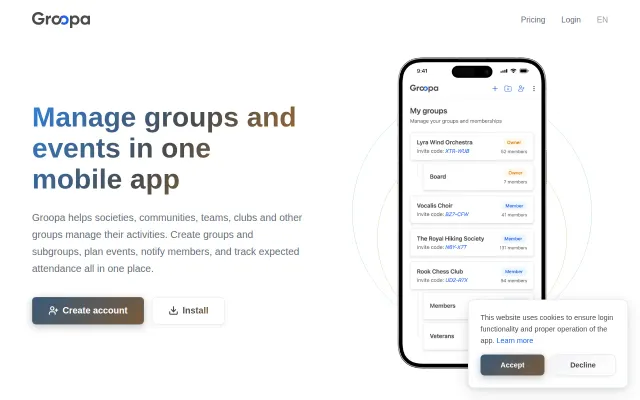
A 7-language PWA built solo under a 100-hour deadline
Yet another group management app competing with Meetup and Facebook Groups.
Ship ItNiche Gem
urostrstenjak
2022d ago
SQL-for-agents concept, but orchestration frameworks already exist; execution clarity unclear.
AI/ML engineers, workflow orchestration specialists, teams building multi-agent systems
Temporal · Prefect · Apache Airflow
For the past few months, I’ve been wrestling with a paradox: Individually, AI agents are incredibly fast. Yet, when deployed as a team, organizational throughput often stays flat. We end up acting as "Human Wrappers," manually marshaling data between probabilistic agents.
I decided to treat this as a systems problem, not a management problem. ODL (Organizational Definition Language) is an attempt to bring a "SQL Moment" to agent organizations. Instead of micromanaging how agents work, ODL lets you declare what the structure should be.
Here is a simplified example of an ODL definition orchestrating a self-correcting team with a human-in-the-loop gate:
approval_gate: target: ArchitectureSpec approver: CTO contents: generate_team: generator: LeadArchitectAgent validators: [SecurityAuditor, PerformanceExpert] loop: 3 inputs: ["BusinessRequirement", "SecurityStandard"] output: ArchitectureSpec briefing: mission: "Design a zero-trust architecture for 10k RPS."
KEY ARCHITECTURAL PILLARS:1. Functional Core / Imperative Shell: We run probabilistic AI on top of a pure, side-effect-free functional kernel (odl-kernel). It takes the current state (Snapshot) and an event, and calculates the exact next transition without hitting databases directly.
2. Deterministic Convergence: To ensure predictable execution of unpredictable agents, the kernel relies on a deterministic loop:
for _ in range(self.MAX_ITERATIONS): has_change = False if self._step_a_transition(...): has_change = True if self._step_b_expansion(...): has_change = True if self._step_c_dispatch(...): has_change = True if not has_change: break # Convergence reached
3. Deterministic Identity: Every node and event is assigned absolute "Space-Time Coordinates" using deterministic UUID v5 generation based on its structural path. Past iterations crystallize into an addressable, immutable history, making the system replayable.THE "CORTEX" EXPERIMENT:
I am a systems architect/PM by trade. In fact, I have absolutely zero Python programming knowledge. To test my thesis that "if the architecture is rigorous enough, execution becomes purely computable," I spent 40 days defining the core principles and designing over 50 architectural proof patterns (Source-to-IR transformations) in YAML.
I treated the YAML test cases as the absolute law; the AI implementation was rejected repeatedly until it achieved 100% coverage and passed all 50+ structural proof patterns.
I functioned purely as the "Cortex" — defining the Why and the What — while forcing the AI to figure out the How. The result is a fully functional, deterministic Python kernel that passes 100% of its tests. It serves as a physical, verifiable manifestation of the ODL spec.
REPOS:
- L1 (odl-lang) Compiler: https://github.com/co-crea/odl-lang (Apache 2.0)
- L0 (odl-kernel) Execution Engine: https://github.com/co-crea/odl-kernel (BSL 1.1 - Ensuring sustainability for the infrastructure while keeping the language open)
This project is dedicated to the memory of my mentor, Prof. Kazuhisa Seta. He taught me that "structure is the essence of intelligence."
I'd love to hear your thoughts on the architecture, the UUID approach, or the concept of defining organizations as code!
Yet another group management app competing with Meetup and Facebook Groups.
Another config standard for AI agents when each harness already has its own format.
Graphql-to-API circuit model is clever, but early stage and narrow use case limits it.
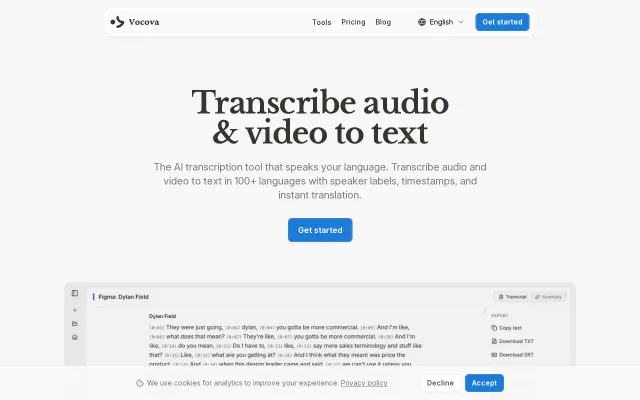
Another transcription SaaS when Otter.ai, Descript, and Rev already dominate the space.
Proof-of-concept flight sim for the author's own Spectre language.
Nine-language code generation with LSP support when Protobuf dominates.