Developer Tools●●Solid
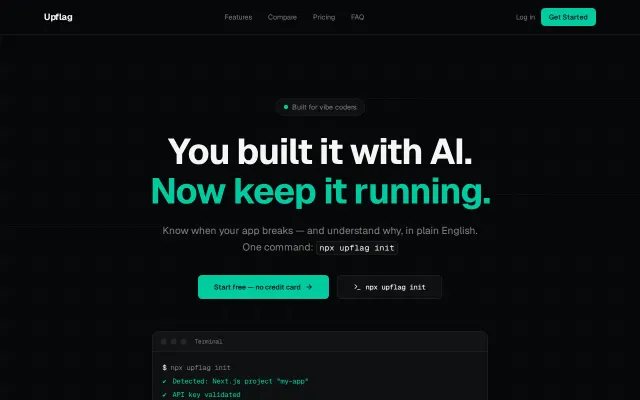
Upflag – Plain-English error alerts for apps built with AI coding tools
Sentry but explains errors in plain English instead of stack traces.
Solve My ProblemSlick
upflag
113mo ago
AI-powered cloud architecture - describe infrastructure in natural language, get Terraform, cost estimates, and compliance reports
Natural language to cloud spec with compliance + cost, but cost accuracy needs work.
Cloud architects, DevOps engineers, infrastructure teams designing systems before deployment.
Brainboard · Pulumi Neo · Infracost
You describe an architecture in plain English. It produces a structured YAML spec (ArchSpec), then gives you:
- Compliance validation: HIPAA, PCI-DSS, SOC 2, FedRAMP, GDPR, Well-Architected - Per-component cost estimates across AWS, GCP, Azure, and Databricks - Terraform/CloudFormation/Mermaid/SBOM export - Drift detection (compare design vs deployed tfstate) - Security scanning (missing encryption, IAM wildcards, open 0.0.0.0/0) - Architecture Decision Record (ADR) generation
Benchmarked against raw Claude Sonnet 4.6 across 54 use cases: cloudwright wins on 6 of 8 metrics. Weakest areas are cost accuracy and import fidelity (both actively improving).
$ pip install cloudwright-ai[cli] $ cloudwright design "3-tier web app on AWS with Redis and RDS PostgreSQL" $ cloudwright validate spec.yaml --compliance hipaa $ cloudwright export spec.yaml --format terraform -o ./infra $ cloudwright security spec.yaml
112 services across 4 providers. 17 starter templates. Pure Python, MIT licensed, no cloud credentials required for design/validate/export.The Databricks provider was the hardest to build — it's an overlay platform (runs on top of AWS/Azure), uses DBU-based pricing instead of per-hour instances, and has no CloudFormation support. Happy to talk through any of the design tradeoffs.
Sentry but explains errors in plain English instead of stack traces.
Workflow-to-agents translator, but visual multi-agent builders already exist (Langflow, Zapier AI).
Plain English to shell commands in zsh, but it's a wrapper around Claude Code.
MCP wrapper around codebase diagramming when Mermaid and PlantUML already exist.
Claims 10-minute production code across domains, but no verifiable build process or runnable examples.
Yet another AI contract reviewer in a saturated market.