Developer Tools●Mid
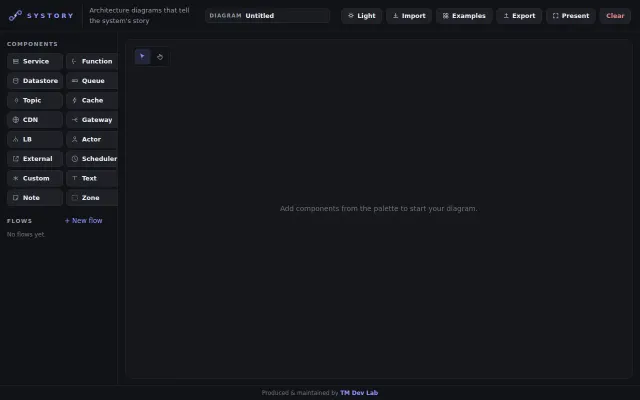
Systory – Architecture diagrams with animated request flows
Animated flows are nice, but Excalidraw and Lucidchart already dominate this space.
Eye CandySlick
thiagomendescwb
1010d ago
Provider-controlled verification constraints for distributed systems. Execution authority remains exclusively scoped to the provider boundary.
Byzantine fault detection without promoting hubs to decision-makers — clever constraint, niche audience.
Distributed systems architects, security researchers, enterprise infrastructure teams
ZeroTrust architecture frameworks · Byzantine Fault Tolerant consensus protocols (PBFT, Raft)
The quorum catches it. Authority never moves.
NUVL fronts compute bindings and forward only. Hubs relay and fan out — no authority, no policy. Providers are the only execution authorities. When Provider_B starts flipping reported outcomes, the 2-of-3 quorum audit detects the drift without promoting hubs into decision-makers.
The drift is deterministic and replayable. You can see exactly when it starts and what the quorum sees.
https://replit.com/@holiwood4420/Two-Region-Quorum-Audit-wit...
Animated flows are nice, but Excalidraw and Lucidchart already dominate this space.
Surfaces decisions on PRs, but tooling assumes decisions are documented—doesn't solve the core problem.
YAML-driven HTTP client when httpie, curl, and Postman already exist.
Catches AI architectural drift locally before GitHub Advanced Security sees it.
YAML process harness that blocks LLMs from skipping steps with receipts.
Finally, HTTP/3 and async in a requests-compatible library after years of feature freeze.