Developer Tools●●Solid
Making remote MCP servers handle local files and generated artifacts
Remote MCP file bridge with sessions and artifact capture, but niche until MCP adoption broadens.
Solve My ProblemNiche Gem
aakashh242
103mo ago
Fills a real gap in remote MCP workflows, but solves a niche infrastructure problem for early adopters.
AI agents using Model Context Protocol servers in remote/containerized environments
Anthropic MCP (upstream standard) · Docker networking layers
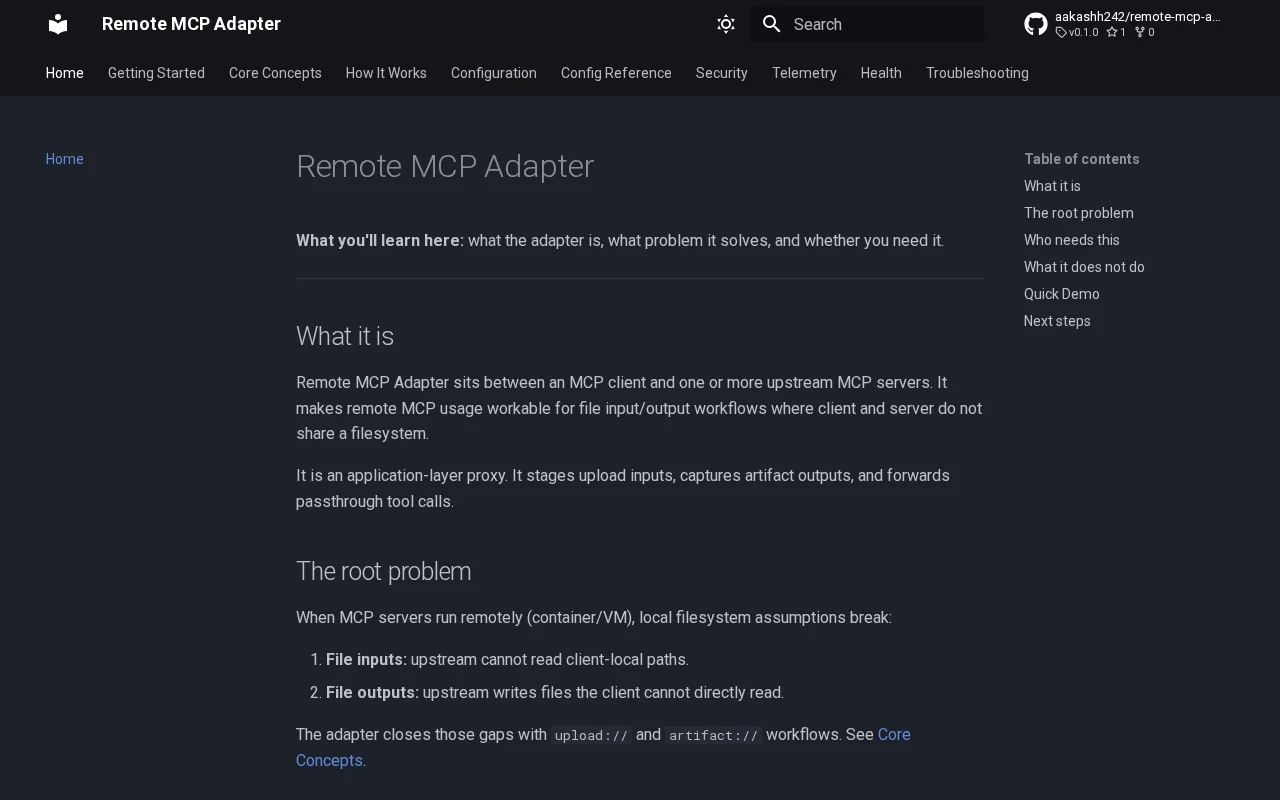
Remote MCP Adapter is an application-layer gateway that sits between an MCP client and one/more upstream MCP servers. It stages inputs as upload handles and captures outputs as MCP resources that the client can read back. It also adds session isolation, automated TTL-based cleanups, quotas, state persistence, health checks and the other standard constructs necessary for a production deployment.
Docs + demo: https://aakashh242.github.io/remote-mcp-adapter/ Code: https://github.com/aakashh242/remote-mcp-adapter
Quickstart is in the README (docker compose spins up Playwright MCP + the adapter) and you point your agent at: http://localhost:8932/mcp/playwright
Would love feedback on edge cases and missing features: artifact capture rules across different servers, guarantee that all requests with a given session_id are consistently routed to the same upstream.
Remote MCP file bridge with sessions and artifact capture, but niche until MCP adoption broadens.
Zero glue code: just prompt an agent connected to two MCP servers.
Another memory layer for MCP when Mem0 and Zep already solve this.
Remote MCP server makes Obsidian vaults accessible from Claude on any device.
CLI + MCP for openEHR workflows; solves real automation pain in healthcare, tiny but validated audience.
Tmux session manager beats SSH juggling, but existing tools cover this space.