AI/ML●Mid
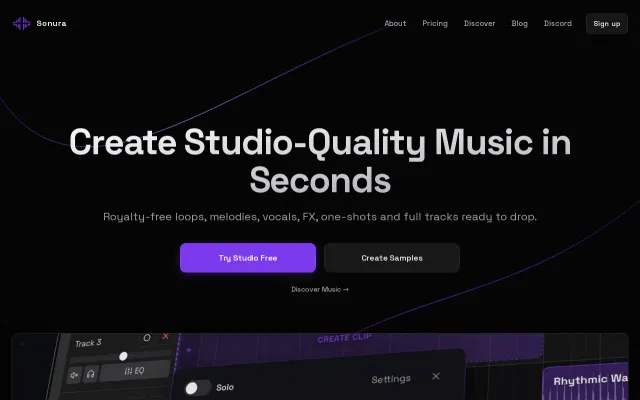
AI Digital Audio Workstation
Another AI music generator when Suno and Udio already dominate.
SlickCrowd Pleaser
kindred
212mo ago
Imbolc DAW - terminal-based digital audio workstation
Full DAW in your terminal, but OSC routing and early alpha mean production use is risky.
Musicians, producers, power terminal users, avant-garde DAW enthusiasts
SuperCollider · ChucK · Nord Lead (hardware)
Imbolc is a DAW that runs entirely in your terminal. It talks to scsynth over OSC and ships 58 instruments and 39 effects. VSTs are a work in progress, also GarageBand loops if you want to recreate "Umbrella".
I used Opus and Codex mainly, but sometimes I had them drive Gemini when I was low on tokens. Some prompts that worked well: "Looking at this codebase, what looks like an obvious retrofit?" "Where can we lean on the compiler?" "Where is it frustrating to work on this codebase". After an agent completed a task, I'd interview it — where did you have trouble, what felt like a hack, what would you do differently. v1 was clojure, v2 was java, v3 is rust. v4 will be stones and sticks.
So nowadays out here in the deep future, I think programming will become a matter of taste. Here's what I think demonstrates my sensibilities:
- Accessibility: This is what I'm most proud of. TUIs are usually terrible for screen readers. In Imbolc, every action in the UI is available as a typed command (after I started typing this up I thought, is that true? turns out it wasn't, so now the compiler enforces this.). - LAN collaboration: Multiple people can connect to a shared session over the local network and share midi clock, tuning, effects buses, etc. Audio is never sent over the network.
- Weird musical choices: With the "Global" just intonation setting, your absolute tuning can drift over time. I was thinking about how an accordion looks kind of like a qwerty keyboard, so I added a quasi Stradella layout. A432 by default, and so on.
- Command palette, themes, keybindings, Diataxis docs.
It requires SuperCollider installed (scsynth on PATH). macOS and Linux 1st class, BSDs are next on the roadmap, no Windows.
It's still alpha, there are plenty of rough edges. But it is genuinely fun to dink around on, I'd love to know what you all think.
https://github.com/mohsenil85/imbolcAnother AI music generator when Suno and Udio already dominate.
Terminal music player bypassing YouTube ads using yt-dlp and mpv.
Solid Rust abstraction for SCSI commands, but existing tools already rip CDs well.
15MB YouTube music player with native audio threading beats Electron bloat entirely.
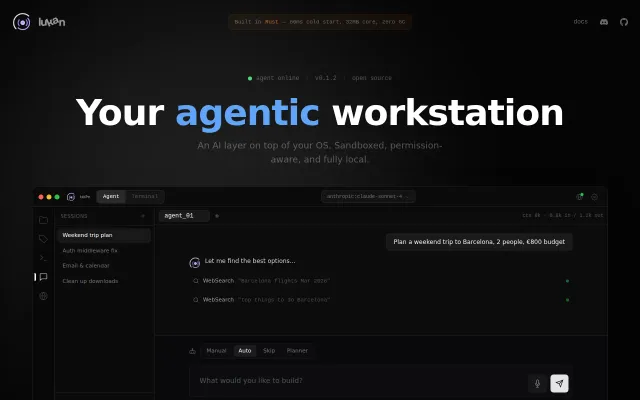
Single Rust binary embedding tmux and multi-agent sessions challenges Electron AI IDEs.
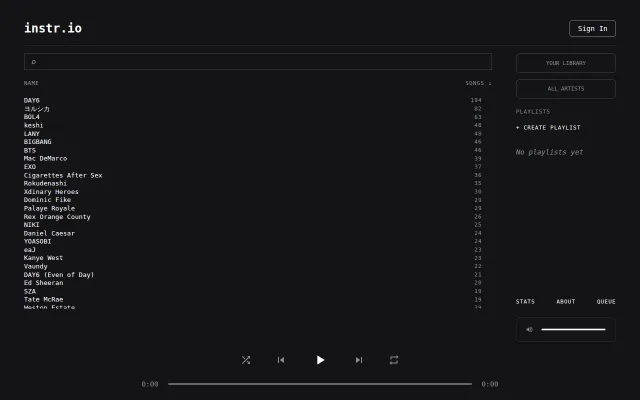
This ships a tidy, browsable library of on-demand vocal removals backed by a custom 'BiMamba UNet' trained on a curated ~500-song dataset — the interface actually feels built for music discovery rather than a bare demo. Don't expect SOTA separations (the author trained on one A40 for days and is honest about limits), but the vibe-coded dataset and integrated conversion pool make it a fun, useful tool for quickly grabbing instrumentals.