AI/ML●●Solid
Gemma 3 inference in pure C++ with Metal acceleration
Pure C++23 Metal inference when llama.cpp already dominates this space.
WizardryNiche Gem
ybubnov
6215d ago
High-performance, deterministic DLinear implementation in Chisel. Sub-5ns latency on 7nm. Target: HFT, Line-rate Networking, and Aerospace RTOS.
Sub-5ns DLinear in silicon. Balanced adder trees, 4-stage pipeline, zero-delay bit shifts.
Hardware engineers, HFT traders, aerospace/real-time systems engineers, academic researchers in AI accelerator design
Well, it wasn't as easy as it seemed... My first attempt at direct synthesis led to a nightmare. OpenLane (the RTL-to-GDSII flow I used) reported a setup slack of -7.88ns. Essentially, the signal was too slow to travel through the 64-tap window within a 100MHz clock cycle. I spent weeks refactoring the architecture in Chisel. I moved to a fully unrolled, 4-stage deep pipeline. The hardest part was balancing the binary adder tree; I had to ensure that the 6 levels of addition didn't bottleneck the entire chip. I also realized that I could cheat a bit: instead of using a resource-heavy divider for the moving average, I used a static bit-shift (>> 6). In hardware, that’s just re-wiring, which costs zero nanoseconds and zero gates. The final result is an 86,443-cell design that is LVS/DRC clean.
Of course, it now runs at 100 MHz on a 130 nanometer process, but physics shows that in theory it is possible to achieve 1.2GHz on a 7 nanometer process, which will reduce the delay to about 3.3 nanoseconds (yes, I did not try ASAP7 in OpenLane, the project is too controversial and I was not sure if it would give realistic results) I think we are now approaching the point where a software-defined interface is becoming too slow for line rate networking or high speed control loops. All GDSII layouts and surfer waveforms could be found in repo
If someone is interested, I'd love to get feedback from the community about the architecture, as there are still some problems with synchronization in the chip, which can cause power consumption to suddenly jump when the chip is running, which leads to the chip going into reboot mode or maybe someone knows a more elegant method for handling the summation of large windows in Chisel.
Pure C++23 Metal inference when llama.cpp already dominates this space.
The repo does one practical thing well: quantify the real-world impact of Apple Silicon's unified memory on analytics by running six TPC-H queries plus a GPU-favorable QX and shipping the raw charts and code. It's specific and empirical — you get MLX vs NumPy vs DuckDB numbers and PNGs, not just hand-wavy claims — but it's narrowly scoped to M4 hardware and small-ish scales, so its conclusions are useful for experimentation rather than sweeping generalization.
Pseudo-academic GPU architecture with no silicon, no benchmarks, no working prototype.
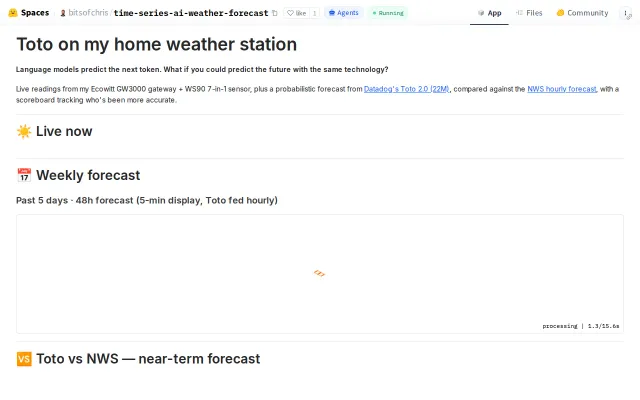
Beating NWS forecasts with a 22M model on home sensor data is genuinely impressive.
MCP proxy prevents context-window bloat better than naive LLM forecasting.
M3/M4 thermal-manager unlock that most older fan tools don't handle.