Other●●Solid
TWFF – A container format for declaring AI use in writing
Deterministic audit trail vs. probabilistic detection, but adoption depends on ecosystem buy-in.
Zero to OneBig Brain
normanbell
253mo ago
Interactive fiction tooling with portable format—but audience is writers, not developers.
Interactive fiction authors, game writers, narrative designers
Twine · ChoiceScript · Ink by Inklewriter
It turned into a software project.
As the story grew, managing the structure quickly became difficult: branches, conditions, narrative state… everything started getting messy.
At some point I opened Visual Studio to try to solve the problem for myself. The initial idea was simple: separate the prose from the runtime logic that drives the story.
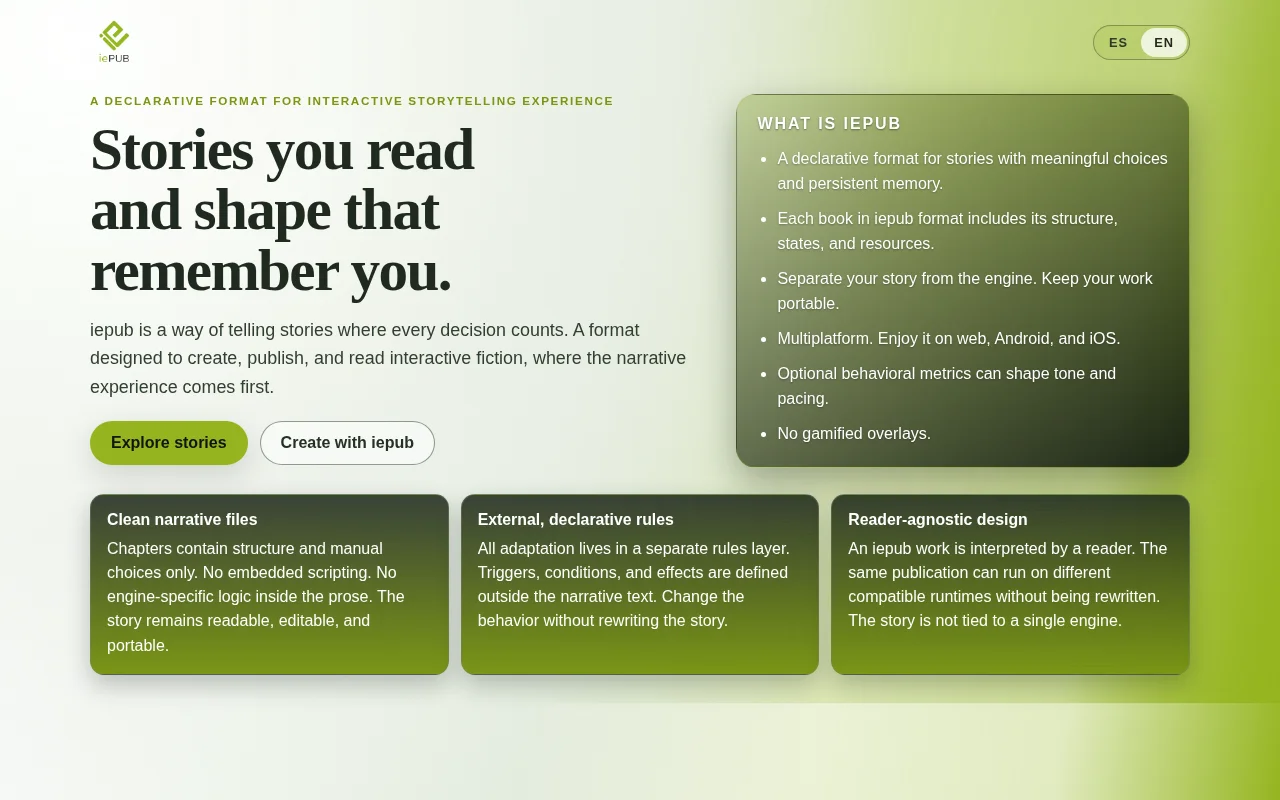
That experiment slowly turned into a small ecosystem called iepub:
• a structured format for interactive books • a reader runtime that interprets that format • and a visual editor designed for writing interactive fiction
The editor tries to feel like a normal writing tool (something closer to Google Docs) but designed for branching narrative. It lets you define narrative conditions, attach variables to sections, configure probabilistic events (like dice rolls), create narrative variants, and visualize the structure of the story as a graph.
Most of the development ended up happening with AI agents (Codex) acting as development partners, which turned into a surprisingly effective workflow for iterating on architecture, UI components and debugging.
If anyone is curious:
Project: https://iepub.io
Article about the development process: https://medium.com/@santi.santamaria.medel/interactive-ficti...
Happy to answer questions about the project, the architecture, or the AI-assisted development workflow.
Deterministic audit trail vs. probabilistic detection, but adoption depends on ecosystem buy-in.
Distraction-free novel writing as a single .html file—no cloud, no subscription required.
Proves AI usage with a verifiable PDF receipt instead of probabilistic detection guesswork.
Figma-like visual editing for React that writes directly to your source files.
Vim keybindings feel natural with normal/insert/visual modes and :wq commands.
Typing-based interactive fiction platform selling narrative adventures like game DLC.