Developer Tools●●Solid
Singularity-Claude – Self-Evolving Skills for Claude Code
Recursive repair loops improve skills automatically, unlike static Claude Code defaults.
Big BrainNiche GemShip It
shmayro
212mo ago
The first open-source GEO linter. 92 rules for SEO, GEO, and content quality — built for AI agents to run, read, fix, and re-lint automatically.
First GEO linter (92 rules for AI search engines), deterministic analysis, agent auto-fix loop with zero hallucination.
Content creators, technical writers, and marketing teams using Claude or AI agents for content production
ESLint (code linting) · Prettier (code formatting)
GEO is the idea that AI search engines (ChatGPT, Perplexity, Claude) cite content differently than Google ranks it. Things like question-formatted headings, FAQ sections, entity density, E-E-A-T signals, and citation-ready statistics all matter for whether an LLM will pull from your content. geo-lint has 35 rules specifically for this.
The interesting part is the lint loop. It ships as a Claude Code skill — you run /geo-lint audit and it spawns parallel subagents, one per file. Each agent reads the violations, edits the content, re-lints, and repeats until clean (max 5 passes). The linter is fully deterministic (no LLM in the rules themselves), so the agent gets unambiguous violation + suggestion pairs to act on. Zero hallucination risk in the analysis layer.
It also works without Claude Code — npx geo-lint --format=json gives you a flat JSON array any agent (Cursor, Copilot, Windsurf) can consume. The rules are the same either way.
MIT licensed, zero runtime deps beyond gray-matter. npm: @ijonis/geo-lint
Recursive repair loops improve skills automatically, unlike static Claude Code defaults.
Claude Code plugin that pauses wasteful ad keywords and fixes SEO issues automatically.
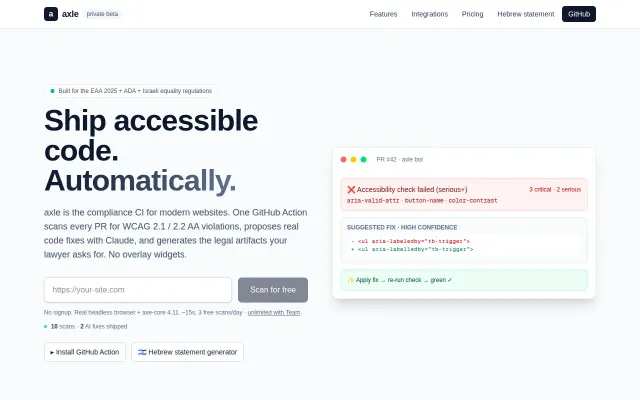
Proposes real code diffs via Claude, unlike axe-core which just reports errors.
The Potatometer nails a fun, focused angle: deterministic SEO checks plus an explicit 'GEO / AI visibility' score and support for modern signals like llms.txt and schema detection. The site promises instant, prioritized fixes (code snippets and time estimates) and a playful 'Potato Scale' that actually helps frame results for non-SEO folks. That said, the real value will hinge on how accurately its checks map to actual LLM citation behavior — the landing page shows confidence but stops short of proof or case studies.
GSC API wrapper for AI agents, but positioning assumes narrow agent adoption.
MCP server scans sites and generates Claude-ready fix prompts for direct editing.