AI/ML●●Solid
Deploy a RAG pipeline as a REST API using RAGLight
Modular RAG with MCP integration, but Langchain and LlamaIndex already dominate.
Ship It
bessouat40
314mo ago
RapidFire AI: Rapid AI Customization from RAG to Fine-Tuning
16-24x faster RAG iteration via shard-based concurrent execution with live control.
ML engineers tuning RAG systems, LLM researchers prototyping at scale
LangChain Experiments · Ragas · Ray Tune
RapidFire uses shard-based interleaved scheduling to run many configurations concurrently on a single machine — even a CPU-only box if you're using a closed API like OpenAI. Instead of config A finishing before config B starts, all configs process data shards in rotation, so you see live side-by-side metric deltas within the first few minutes.
The part we're most excited about: Interactive Control (IC Ops).
Most RAG observability tools tell you what happened after a run finishes. IC Ops closes the loop — you can act on what you're observing mid-run:
- Stop a config that's clearly underperforming (save the API spend) - Resume it later if you change your mind - Clone a promising run and modify its prompt template or retrieval strategy on the fly, with or without warm-starting from the parent's state
This changes the experimentation workflow from "observe → write notes → re-queue a new job" to "observe → fix → continue" in a single session.What you can experiment over in one run: - Chunking strategy and overlap - Embedding model - Retrieval k and hybrid search weighting - Reranking model / threshold - Prompt template variants (few-shot, CoT, context compression) - Generation model (swap GPT-4o vs Claude 3.5 vs local model mid-experiment)
Eval metrics aggregate online (no need to wait for full run), displayed in a live-updating in-notebook table. Full MLflow integration for longer-term experiment governance.
GitHub: https://github.com/RapidFireAI/rapidfireai
Docs: https://oss-docs.rapidfire.ai
pip install rapidfireai
Modular RAG with MCP integration, but Langchain and LlamaIndex already dominate.
Chunk-level incremental sync saves 67% embedding calls on partial document edits.
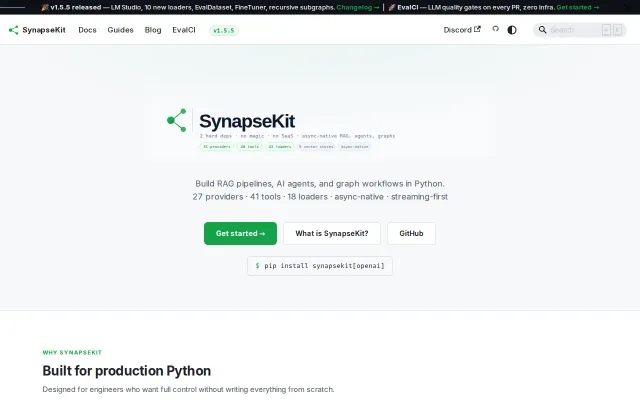
LangChain alternative with 2 dependencies and async-native architecture from the start.
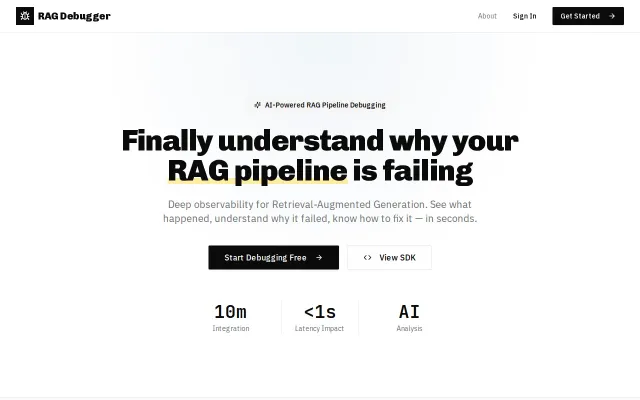
Relevance scores and hallucination detection when LangSmith already exists.
Focuses on pre-retrieval document classification to fix context quality, not just embedding search.
RAG library with serve command, but Langchain, LlamaIndex, and Verba already dominate.