Developer Tools●●●Banger
RedDragon, LLM-assisted IR analysis of code across languages
LLM-assisted IR repair for decompiled and incomplete code across 15 languages.
WizardryBig BrainNiche Gem
armorer
213mo ago
Multi-language code execution through a simple IR and deterministic VM with LLM repair / patching
LLM-assisted compiler frontend for 15 languages, but unclear if it outperforms static AST analysis alone.
Security researchers, legacy code auditors, binary analysis engineers
Joern · CodeQL · Ghidra
RedDragon has three specific insertion points:
- LLM as an alternative compiler frontend. For languages without a built-in parser, the LLM receives a formal IR spec (all 27 opcodes, lowering templates, worked examples) and translates source to IR directly. No language-specific code needed. This works for Haskell, Elixir, Perl — anything with parseable source.
- LLM for syntax repair. When the parser hits a parse error in malformed source, an LLM fixes the broken spans and the system re-parses. The repair is constrained to syntactic fixes; the LLM doesn't change what the code does.
- LLM as runtime resolver. When the VM hits a call to a function that doesn't exist in the IR (e.g., requests.get()), an LLM can produce plausible return values and side effects, so that execution continues through incomplete code.
All three are optional. When code is complete and well-formed, the pipeline makes zero LLM calls. When an LLM fails at any point, the system falls back to symbolic placeholders and keeps going.
LLM-assisted IR repair for decompiled and incomplete code across 15 languages.
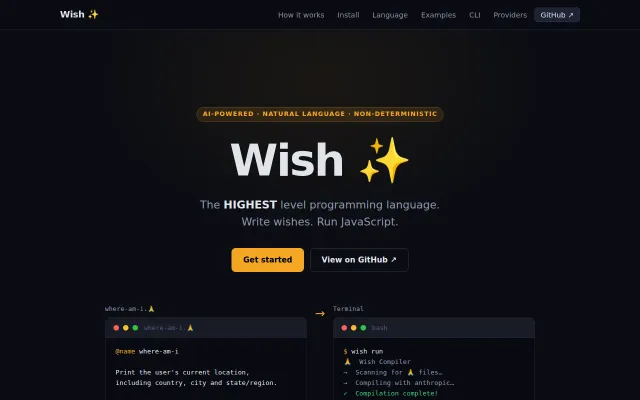
Non-deterministic compilation via LLM — every natural language programming attempt has failed for decades.
Compiler build log video, but the language itself has no ecosystem.
Tree-sitter + LLM codebase mapping, but Cursor, Continue, Sourcegraph already do this.
Tree-sitter + Rhai scripts replace opinionated formatters, but beta stability and language coverage remain questions.
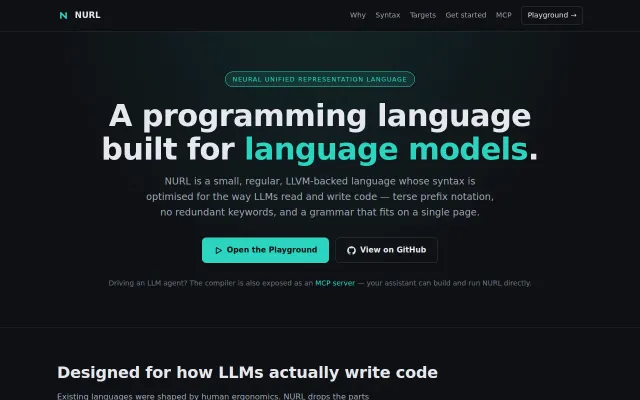
Prefix notation language that cuts LLM token usage by 70% compared to Python or C.
![Building compiler from scratch without the help of LLMs [video]](/screenshots/47821137_thumb.webp)