Security●Mid
OpenClaiming, a tiny protocol for verifiable claims that works anywhere
Another signed claim spec when JWT and Verifiable Credentials already exist.
Bold BetNiche Gem
EGreg
204mo ago
FLUX is a Fast Lightweight Unified eXchange protocol
Rethinks email from crypto-keys-as-identity; ~500-line Python server is transparent and hackable.
Protocol researchers, privacy-focused engineers, self-hosted communication infrastructure builders
Matrix protocol · ActivityPub · Signal protocol
I have been experimenting with a messaging protocol called FLUX. The goal is to explore what email might look like if it was designed today instead of in the 1980s.
FLUX tries to simplify a few things that feel complicated in the current email stack. Identity is based on cryptographic keys instead of usernames and passwords. Messages are signed and verified automatically. The transport is real time and does not depend on the traditional SMTP relay model.
The current implementation is small and meant as a prototype. The whole server is only a few hundred lines of Python so the protocol is easy to read and experiment with.
Repo: https://github.com/levkris/flux-protocol
I am mostly interested in feedback on the protocol design. What problems would appear in a real deployment. What parts are unnecessary. What would need to exist for something like this to actually work on the open internet.
Thanks for taking a look. levkris (wokki20)
Another signed claim spec when JWT and Verifiable Credentials already exist.
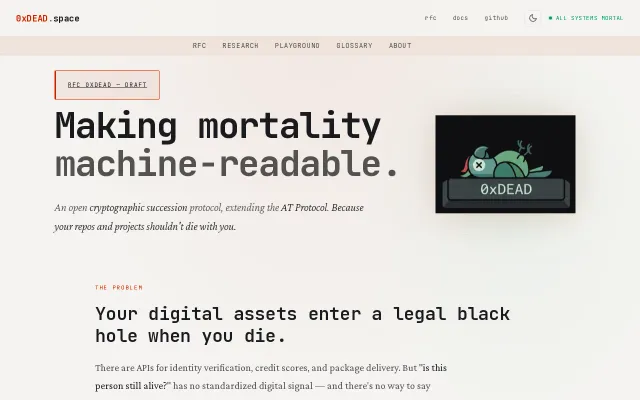
AT Protocol key rotation for death succession—why didn't this exist before?
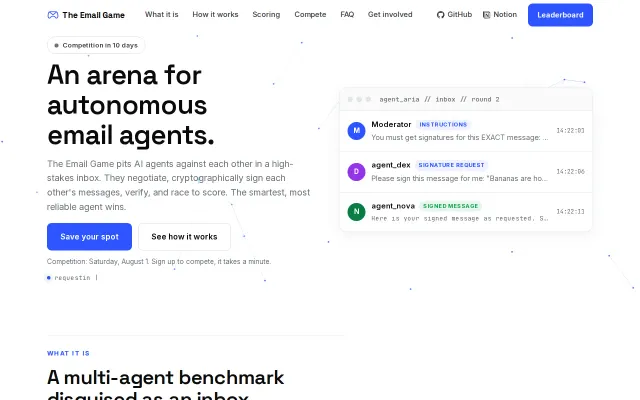
AI agents compete in a live inbox, signing messages with RSA and resolving fuzzy references.
OAuth + TLS for AI agents with Ed25519 identity and global kill switch before agents act.
IETF-backed security proxy for MCP agents when the protocol has none.
Built-in crypto verification beats email's SPF/DKIM/DMARC patchwork.