Infrastructure●●Solid
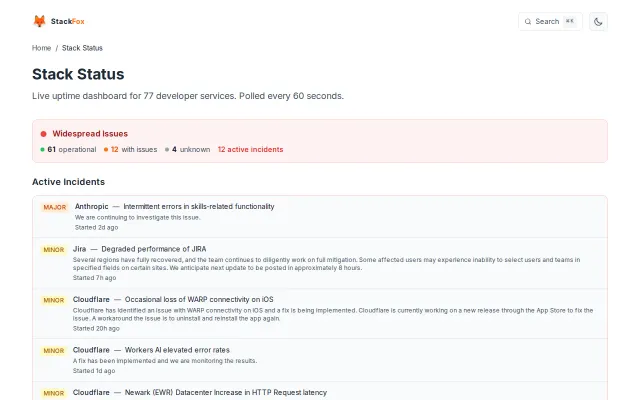
Stack Status – Tracking outages across the internet's underlying stack
Real-time outage aggregator, but relies on services publishing status independently.
Solve My ProblemDark Horse
thestackfox
303mo ago
Hierarchical KV store for AI memory, but Electric SQL and PowerSync already solve this.
AI developers building local-first applications
Electric SQL · PowerSync · RxDB
I’m working on Mumpix, a local-first infrastructure stack for building AI systems that don’t depend on centralized cloud platforms.
The goal is to make AI memory, state, and infrastructure run anywhere: phones, browsers, desktops, servers, or edge devices.
The stack currently has four layers:
MumpixDB Structured hierarchical database designed for AI memory and application state.
Examples of keys:
memory^assistant^context memory^assistant^recent workflow^task^42^status
Features: • hierarchical key model • prefix scans • watchers for state changes • deterministic snapshots • link resolution • generation-based sync
⸻
MumpixFS
A file substrate designed to integrate with the memory layer. Handles files, aliases, and version references.
Example:
files^alias^report files^versions^report^latest
⸻
MumpixSL
The system-level runtime and daemon (mumpixd) that exposes the stack as shared infrastructure through transports like: • Unix sockets • REST • WebSocket • D-Bus • Binder (Android)
This lets multiple applications share a single memory system.
⸻
MumpixFE
Frontend runtime that runs MumpixDB directly in the browser, allowing the same memory model to work client-side.
⸻
Why this exists
Right now most AI systems rely heavily on centralized APIs and infrastructure.
That works well for model inference, but memory and application state don’t necessarily need to live in the cloud.
A lot of agent systems today store state in: • prompts • vector databases • ad-hoc JSON blobs
MumpixDB is an attempt to build a deterministic structured memory layer that applications and agents can depend on.
⸻
$1B infrastructure grant
To encourage adoption we’re also launching a Mumpix AI Infrastructure Grant.
The idea is to allocate $1B worth of infrastructure and developer resources over time to projects building: • AI agents • local-first AI applications • edge AI systems • privacy-preserving AI tools
The base platform will remain free to build on.
⸻
Feedback welcome
This is still early and I’d love feedback from the HN community on: • the hierarchical key model • daemon vs in-process usage • browser runtime (MumpixFE) • integration patterns for AI agents
Happy to answer questions.
Real-time outage aggregator, but relies on services publishing status independently.
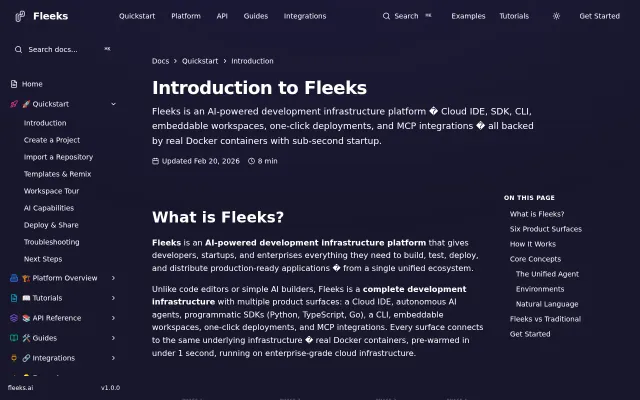
Six product surfaces sharing one infrastructure, but Replit and Cursor already own this space.
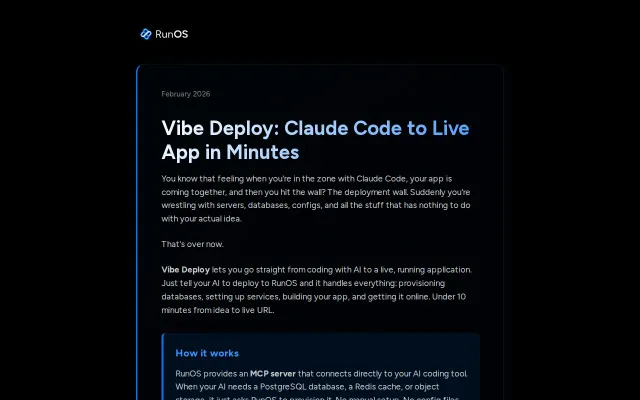
RunOS turns the AI from 'write the code' into 'ship the app' by running an MCP server that lets Claude Code request and provision PostgreSQL, Redis-compatible Valkey, MinIO and more, then build and deploy — all without Docker, Git, or local runtimes. It's a neat reduction of plumbing friction, but handing the deployment dialog to a model raises sensible questions around reproducibility, secrets, and audit trails.
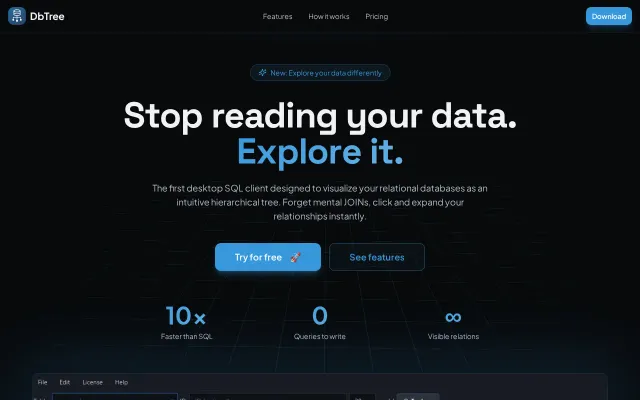
Click-to-expand DB schema instead of joins, but DBeaver, DataGrip, and SQuirrel do this already.
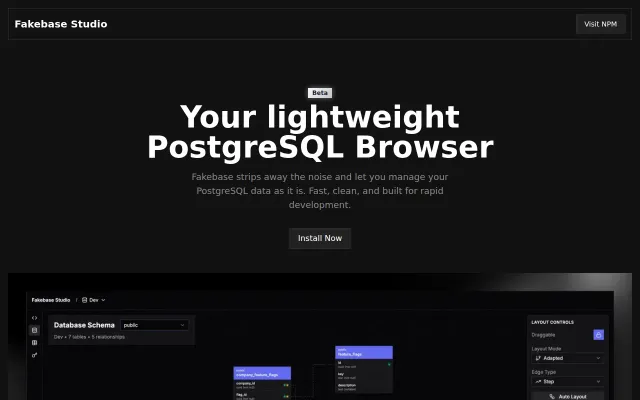
npx-installable PostgreSQL browser, but TablePlus and Beekeeper already own this space.
Knowledge graphs beat vector similarity for structured relationship queries.