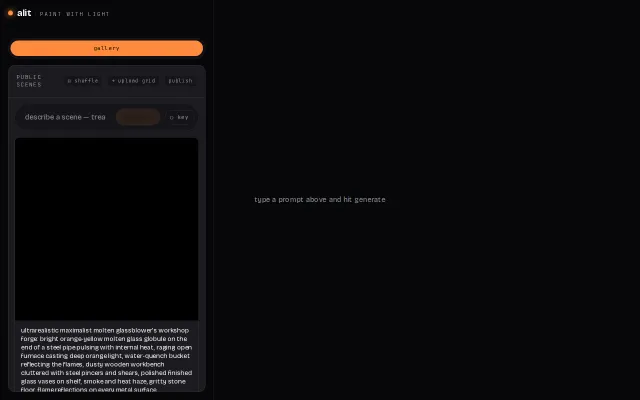
This is a material solver for 3D scans that used flash photographs. I've only tested it on Chrome desktop (doesn't seem to work on a phone yet). The usual scanning programs give you a shape and color based on the photos, but this one also gives texture maps for materials. So the usual rendering model ("Disney BRDF" / Cook-Torrance and variants in Blender, UE, Unity, etc.) takes in diffuse reflectance, "metalness", "roughness", which change based on the physical materials that made up whatever you're scanning.
The idea is that if you use flash photographs, in your renderer, you can solve backwards to see which inputs give a really close render to the photographs at each point, and it all turns into nonlinear least squares for each texel. There's two academic papers that do this and also a startup, m-xr.com (they're calling their program "marso"), this online version I made happens to be a few times faster than both. Which, they're clocking times in the hours range with their expensive server PC with four GPUs, so I thought faster is good.
One neat thing I did, for the solving, WGSL (webgpu shading language) doesn't have templating or function overloading, which all the solver libraries need to do auto-derivatives on equations. So I wrote a python script that generated the equivelant wgsl instead, so the derivatives get generated and you don't need to do it by hand still, then solving can happen on compute shaders with that.
I wrote about it here too: https://www.reddit.com/r/photogrammetry/comments/1rt06rm/i_m...
p.s. I'm looking for work rn, market's awful