Infrastructure●●●Banger
Cycles – hard limits on agent actions before execution
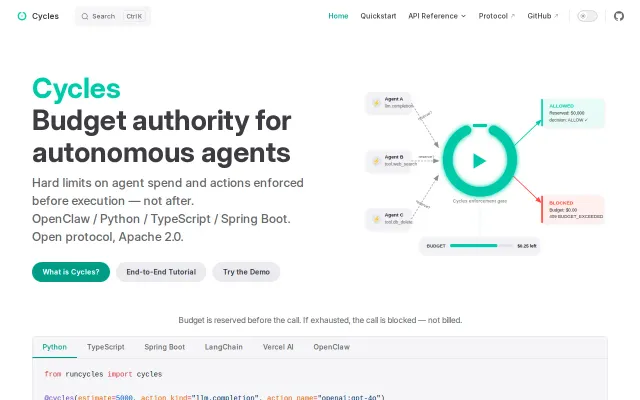
Reserve-commit lifecycle blocks agent actions before execution, unlike standard rate limiters.
Solve My ProblemBig BrainShip It
amavashev
123mo ago
Runaway AI agent spend prevention — demo using Cycles ($6 in 30s → hard stop at $1)
Pre-execution budget reservation stops runaway agents before they burn $200.
Teams running autonomous AI agents in production
Helicone · LangFuse · Braintrust
The pattern is always the same: an agent retries, fans out, or loops. Each iteration passes individual rate-limit checks. Observability fires an alert after the money is gone. Provider caps are per-provider, not cross-provider. None of these stop the spend before it happens.
RunCycles takes a different approach: reserve budget before the call, commit actual spend after, release the remainder if the work is cancelled. The reservation is atomic across all affected budget scopes — tenant, workspace, agent — using Redis Lua scripts so concurrent agents sharing a budget can't collectively overrun it.
The integration surface is small:
@cycles(estimate=50_000, action_kind="llm.completion", action_name="gpt-4o") def call_llm(prompt: str) -> str: return openai.complete(prompt)
When budget is exhausted, the next reservation attempt gets a 409 BUDGET_EXCEEDED before the downstream call is made.The architecture is three pieces:
- Cycles Protocol: an open OpenAPI spec defining the reservation lifecycle, idempotency semantics, scope hierarchy, and overage policies. - RunCycles Server: Spring Boot + Redis, implements the spec. Runs in Docker. - Clients: Python, TypeScript, Java/Spring Boot.
The hardest part was idempotency under retries — if a commit fails transiently and retries with the same key, it should get the original response back, not double-charge. The Lua scripts handle this atomically.
What it's not: a billing system, observability dashboard, or agent framework. It's the layer that decides whether an action may proceed before it proceeds.
Org: https://github.com/runcycles Docs: https://runcycles.github.io/docs
Reserve-commit lifecycle blocks agent actions before execution, unlike standard rate limiters.
Reserve-before-execute budget protocol prevents agents from burning money unexpectedly.
Interceptor layer blocks SQL injection and shell injection before agents execute them.
Three-line API integration blocks risky trades, cuts max drawdown 29% while improving win rate.
Kernel interception stops runaway agents where LangGraph and AutoGen only advise.
Constitutional governance for AI agents beats prompt injection with pre-execution enforcement.