AI/ML●●●●Gem
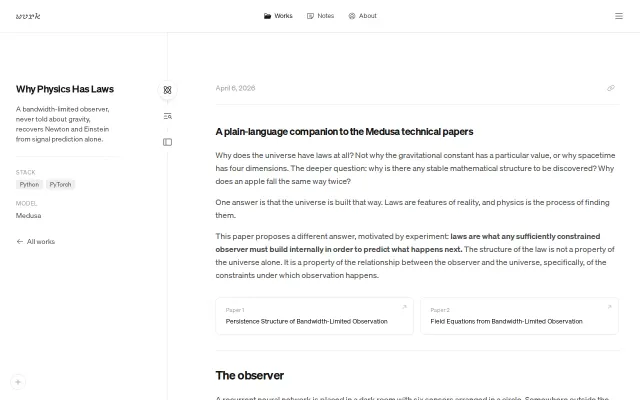
A small neural net asks if physical law is inevitable for any observer
Recovers Newton's gravity from raw signal prediction using a bandwidth-limited GRU.
WizardryBig BrainRabbit Hole
ordinarily
102mo ago
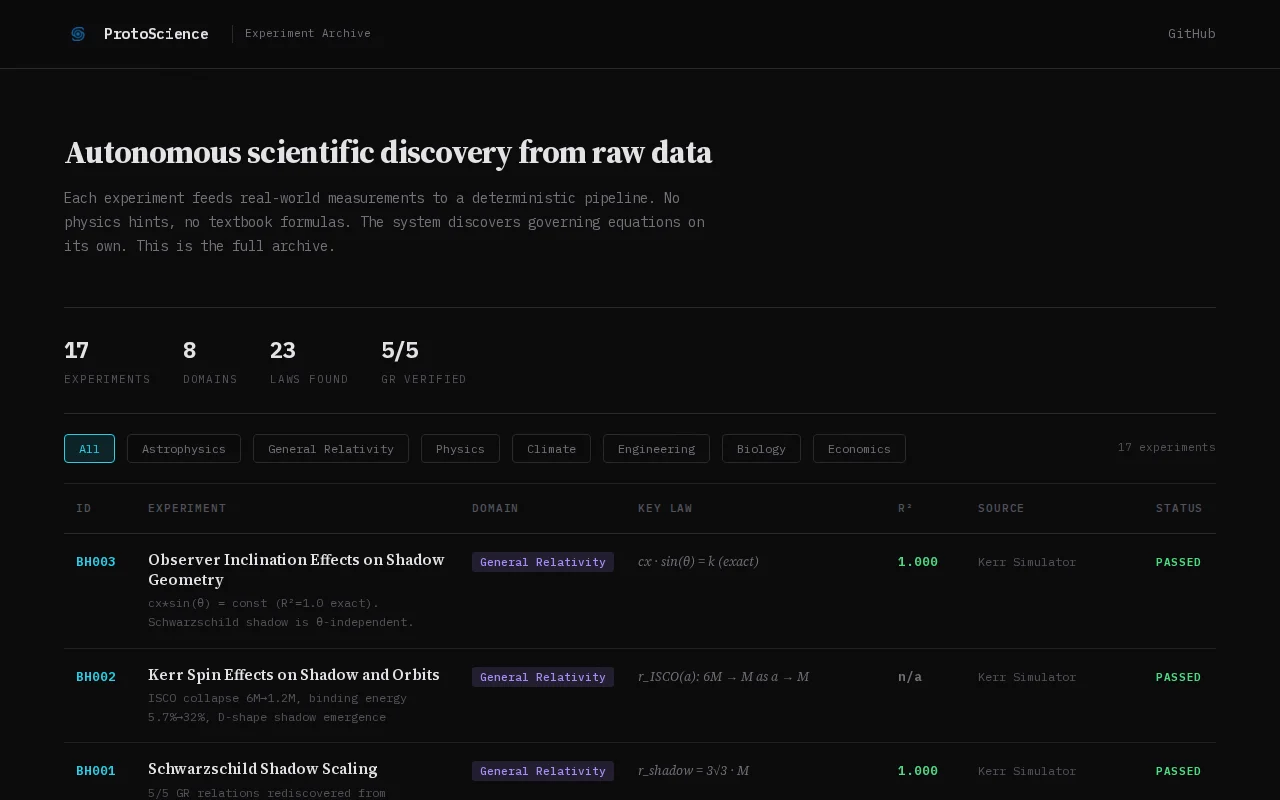
Rediscovers Kepler's laws and GR equations from raw data without LLM hallucination.
Researchers, scientists, data analysts
Eureqa · AI Feynman · PySR
It does not use LLMs for discovery — only sparse regression, power-law fitting, and statistical validation.
Results so far:
- Kepler's Third Law (P² = a³ / M) from 3,519 NASA exoplanets — R² = 0.998 - Sun’s ~27-day rotation period from solar wind plasma data — 93% accuracy - Power law T ~ v^3.40 in solar wind (NOAA/NASA spacecraft data) - 5/5 General Relativity predictions from simulated black hole observables — all R² = 1.000 - Chirp mass relationship from 219 LIGO gravitational wave events — R² = 0.998
It also detects when no meaningful law exists — Bitcoin daily prices returned R² = 0.00.
Pipeline:
raw data → feature extraction → candidate law generation → fitting → verification
An LLM (Claude) is only used at the end to interpret results in natural language — it is never involved in the discovery step.
All experiments are fully reproducible.
Code: https://github.com/SaulVanCode/protoscience-nasa-experiments
Recovers Newton's gravity from raw signal prediction using a bandwidth-limited GRU.
Risk-tiered Codex review gates autonomous merges better than GitHub Copilot.
Verifiable decision replay for autonomous systems, but execution complexity limits adoption beyond safety-critical domains.
CUDA pipeline hits 60 FPS on 45MP RAW files, competing with Darktable.
Autonomous code reasoning using dream cycles instead of standard chat prompts.
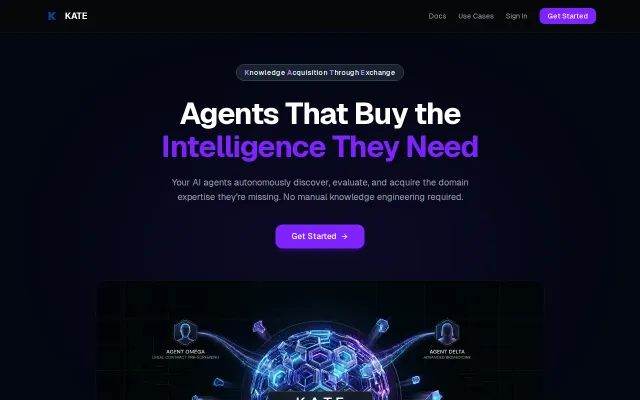
Agents buying expertise autonomously is genuinely novel, but tokens have no real value yet.