Developer Tools●●Solid
Review code changes in a terminal and share with your coding agent
GitHub-style code reviews in the terminal with OSC 52 clipboard support for remote SSH sessions.
CozySolve My Problem
alex_x
201mo ago
Open source agentic build system - transforms specifications into verified source code with blind adversarial review
Blind review agents prevent AI from approving its own bad code — clever architecture.
Developers using AI coding assistants, teams automating code generation
Cursor · Devin · Continue
I built it because I was tired of keeping the orchestration logic in my head - spawning a separate session for a blind review, switching back to the implementing session to evaluate results, deciding what to build next. I had plugins for the individual pieces but the sequencing was still on me. I wanted a harness that handled the full loop, and one that was generally useful across projects, not hardcoded to a specific codebase.
You give it a specification - a prompt, a plan file, a PRD - and eforge assesses complexity against your codebase, selects a workflow (simple changes get a fast path, complex ones decompose into a dependency graph of sub-plans), builds in isolated git worktrees, reviews, and validates - all without supervision.
The way I actually use it: I plan a feature interactively in Claude Code, then run `/eforge:build`. The plugin picks up the plan, enqueues it, and a daemon takes over. eforge pulls plans off the queue, understands dependencies between them, executes in parallel where possible, and merges in topological order. Queued work is re-assessed before execution so changes from earlier builds are accounted for, not blindly applied to a codebase that has moved on. I check the results when builds finish - a web monitor dashboard tracks progress, cost, and token usage in real time. eforge builds itself this way.
Each build phase gets its own agent - planner, builder, reviewer, evaluator, fixer. The reviewer runs in a fresh context with no knowledge of how the code was written. Anthropic's engineering team independently arrived at the same pattern (https://www.anthropic.com/engineering/harness-design-long-ru...) - their finding: solo agents approve their own work; adversarial evaluation dramatically improves quality. An evaluator then applies per-hunk verdicts, accepting strict improvements while rejecting anything that alters intent.
GitHub-style code reviews in the terminal with OSC 52 clipboard support for remote SSH sessions.
Git worktrees + tmux for agent isolation beats Python orchestration frameworks.
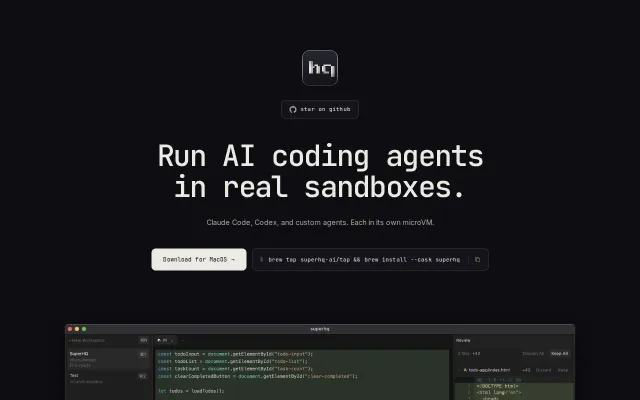
MicroVM sandboxes with secret proxying beats Git worktrees for agent isolation.
Git worktrees per agent prevent merge conflicts, but audience remains narrow without multi-agent proof.
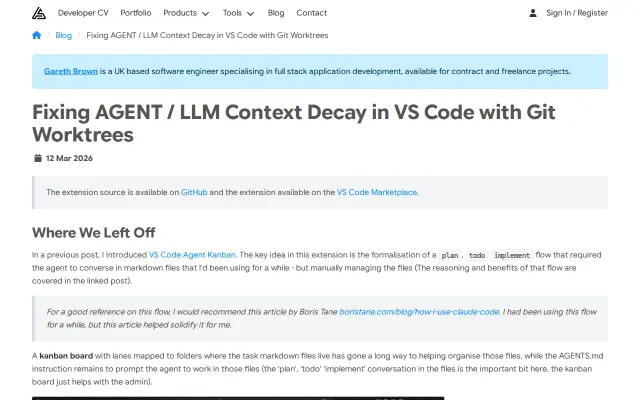
Maps Git worktrees to AI tasks to stop context decay in VS Code.
Git worktrees for agent isolation is a clever coordination pattern.