Data○Pass
For 10 World Cups, my model's 2 favorites had the champion every time
SSRN paper behind a Cloudflare wall with no code or demo.
fabioricardo7
38526d ago
Economic theory paper, not a tool — interesting model but nothing to actually use.
Economists, tech founders, AI researchers studying market dynamics
Personal version: I've vibe-coded maybe 15 projects since the beginning of this year. Two are still alive. At work, our teams built hundreds of custom GPTs and dashboards. Handful survived. The failure mode was never "couldn't build it" - it was "nobody had the bandwidth to care."
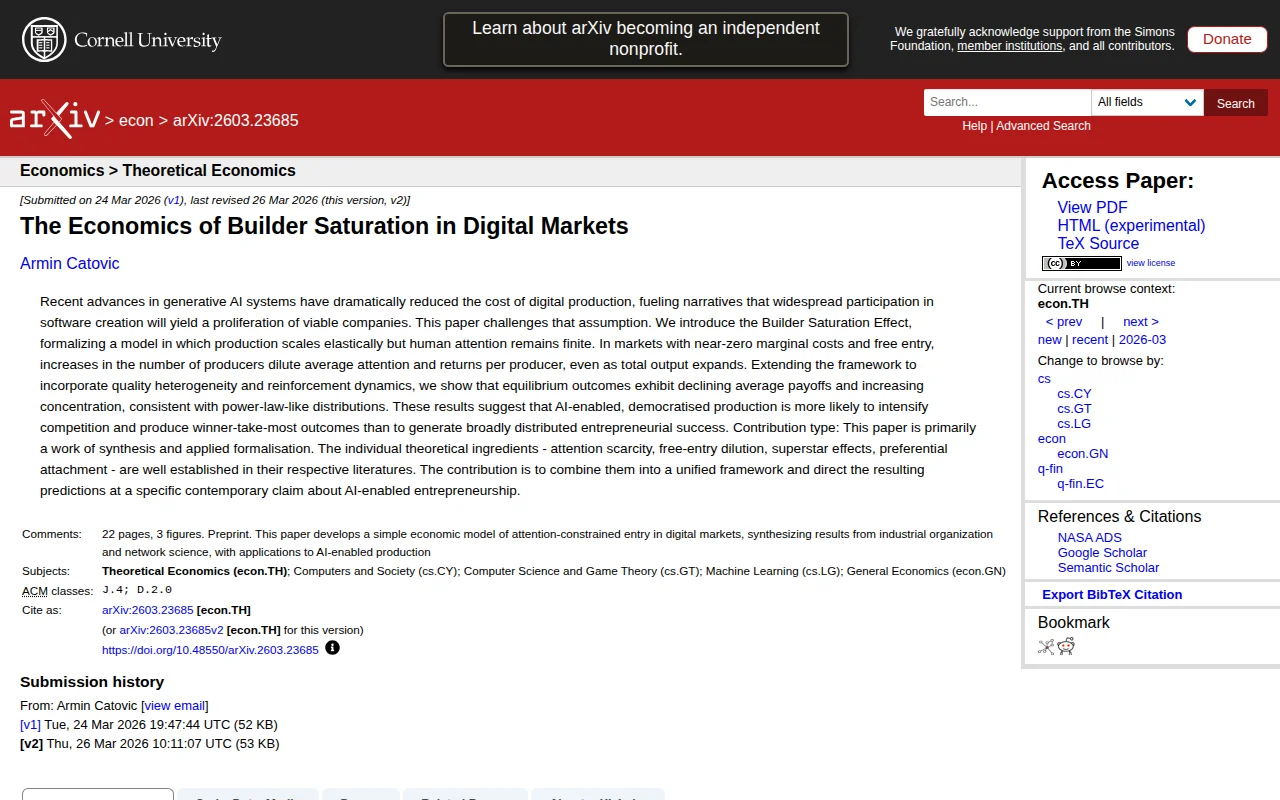
So I wrote a paper about it. It combines Herbert Simon's attention scarcity, free-entry IO models, superstar economics, and preferential attachment into one framework. The central result: equilibrium attention per builder = k/p (entry cost over monetisation rate), independent of market size. As AI drives k towards 0, that ratio vanishes regardless of how much the market grows. Free entry absorbs everything.
Calibrated to the App Store (800K publishers, 38B downloads) the model matches observed concentration pretty well - top 1% get ~70% of downloads, quarter of apps under 100 downloads, Gini above 0.9.
The same mechanism works inside organisations (dashboard sprawl, GPT graveyards, tool fatigue) and across markets. It's the same math: finite attention, elastic production, winner-take-most.
I just got a bit fed up with the narrative I am constantly seeing online: that everyone will be a successful builder with AI; just build; forget about "everything else" that you do - if you aren't vibe coding, you aren't doing anything. And I'm saying this as an AI engineer who has built dozens of models and in the recent times many apps with Claude Code and Codex. I thought it's time to shine some mathematics on this.
Paper: https://arxiv.org/abs/2603.23685
PS. I was very inspired by Herbert Simon (Nobel Prize in Economics) and ironically enough, he is also considered one of the "founders of AI".
SSRN paper behind a Cloudflare wall with no code or demo.
Agent-based market simulation beats surveys, but no proof it predicts better than founder intuition.
Citation-grounded synthesis beats generic RAG wrappers for academic rigor.
Letterboxd for academic papers fills a gap no existing platform addresses.
OpenAlex wrapper with a clean UI, but lacks unique discovery features.
arXiv-first paper manager with network graph viz, but Zotero already owns this space.