Developer Tools●●●Banger
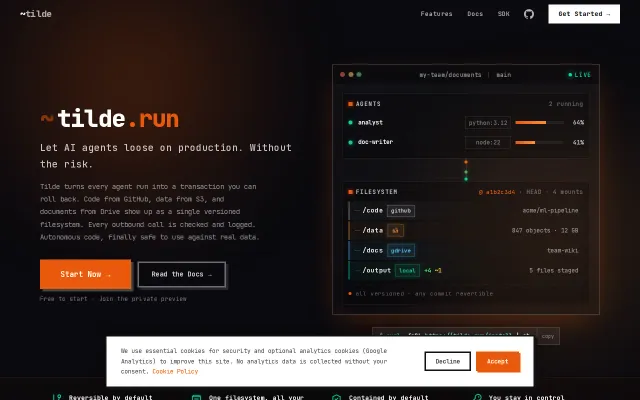
Tilde.run – Agent Sandbox with a Transactional, Versioned Filesystem
Roll back any agent run like a Git commit with a single command.
SlickSolve My ProblemBig Brain
ozkatz
2051331mo ago
productivity-focused sandboxing for Linux
Virtualenv-style sandboxing with namespace isolation for runaway LLM agents.
Linux developers, engineers running local LLM agents
Firejail · Bubblewrap · Docker
The workflow is inspired by Python's virtualenv: create an environment, enter it, work normally - but with enforced sandboxing. To create a new Drop environment and run a sandboxed shell you simply:
alice@zax:~/project$ drop init Drop environment created with config at /home/alice/.config/drop/home-alice-project.toml alice@zax:~/project$ drop run (drop) alice@zax:~/project$ cat ~/.ssh/id_rsa cat: /home/alice/.ssh/id_rsa: No such file or directory
Each Drop environments gets its own, isolated and easily disposable home dir. To ensure the sandbox matches your actual work environment, selected files and dirs from your original home dir are mounted in the sandbox, most of them read-only.The need for a tool like Drop had been with me for a long time. I felt uneasy installing and running out-of-distro programs with huge dependency trees and no isolation. On the other hand I dreaded the naked root@b0fecb:/# Docker shell. The main thing that makes Docker great for deploying software - a reproducible, minimal environment - gets in the way of productive development work: tools are missing from a container; config files and environment variables are all unavailable.
The last straw that made me start building Drop was LLM agents. To work well - compile code, run tests, analyze git logs - agents need access to tools installed on the machine. But giving agents unrestricted access is so clearly risky, that almost every discussion on agentic workflows includes a rant about a lack of sandboxing.
Thanks, I'd love to hear what you think.
Roll back any agent run like a Git commit with a single command.
direnv auto-activation with bubblewrap sandboxing isolates agents per project.
Hardware-isolated VM sandbox for Claude, 2-second boot, no Docker complexity.
Octelium identity proxy eliminates credential injection in sandboxes.
Identity-based sandbox access eliminates credential sprawl better than Codespaces or E2B.
Virtualenv for system isolation—your configs carry over but SSH keys stay protected.