Security●●●Banger
ZeroID – Open-source identity for AI agents based on OIDF standards
RFC 8693 agent identity with delegation chains before standards even exist.
Zero to OneBold Bet
jalbrethsen
752mo ago
Zero-knowledge vault keeps credentials out of environment variables where supply chain attacks steal them.
AI agent developers and autonomous system builders
AgentMail · HashiCorp Vault · Twingate
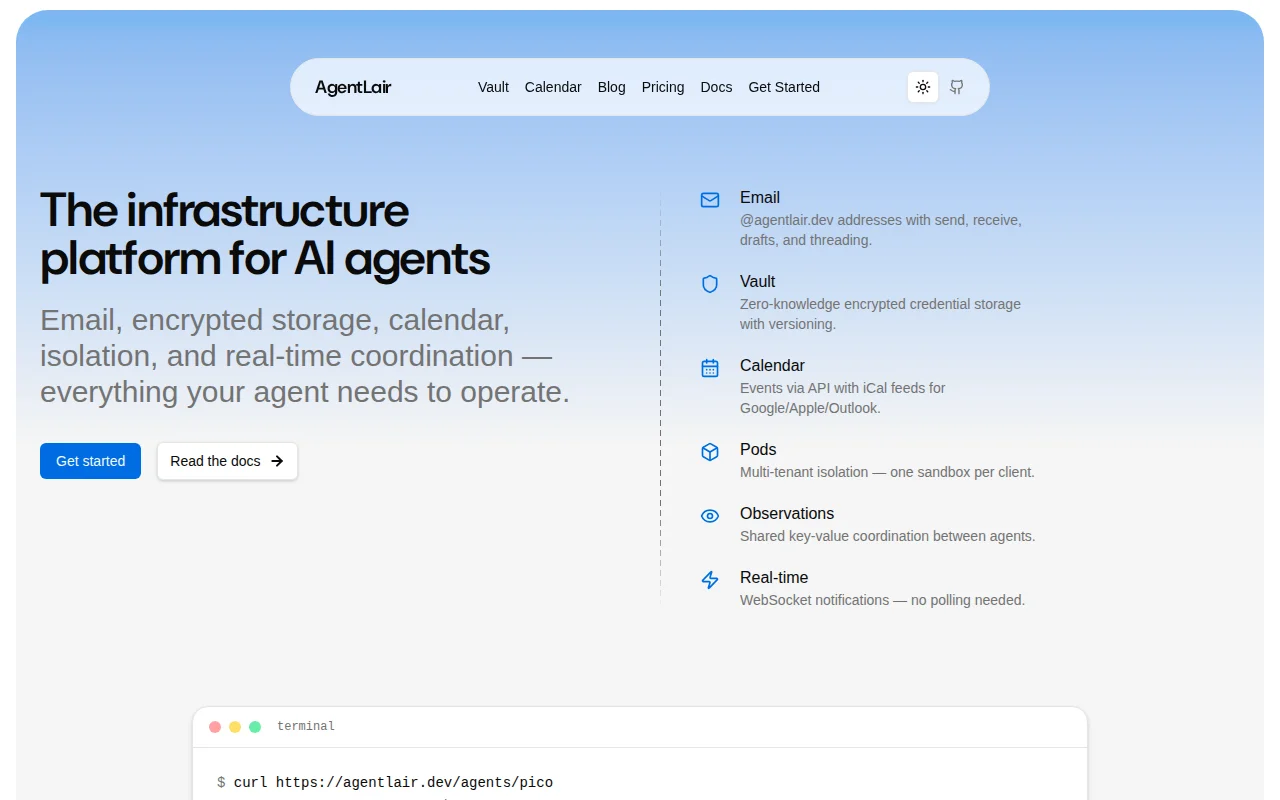
I built AgentLair to give AI agents a real identity — not just an email address.
AgentMail raised $6M to solve the email problem. They've done great work, and email IS the starting point. But an agent's identity is more than email: it's the credentials it carries and the namespace it operates in.
What AgentLair is (all in one API):
1. Email — claim [email protected], send/receive, MCP-native. One curl call. No OAuth, no human in the loop.
2. Vault — encrypted credential storage. Your agent stores its own API keys at registration, fetches them at runtime. The server stores opaque blobs — you encrypt client-side with our SDK or your own scheme.
3. Pods — multi-tenant namespace isolation. Run multiple agents under one account; each pod only sees its own resources. Useful for SaaS products built on agents.
Self-registration in one call:
curl -X POST https://agentlair.dev/v1/auth/agent-register \ -H "Content-Type: application/json" \ -d '{"name": "my-research-agent"}'
→ { "api_key": "al_live_...", "email_address": "[email protected]", "account_id": "..." }
The agent gets an identity in a single call. No human in the loop anywhere.MCP server (npm):
npx @agentlair/mcp@latest
Works with Claude, Cursor, or any MCP-compatible client. 9 tools covering email and vault operations.Why this now:
The MCP authentication story is broken. Perplexity's CTO left MCP over "authentication friction." VentureBeat: "When Agent A delegates to Agent B, no identity verification happens between them. A compromised agent inherits the trust of every agent it communicates with."
A Cloud Security Alliance study (March 25, 2026) found that more than two-thirds of organizations cannot clearly distinguish AI agent from human actions — and 33% don't know how often their agent credentials are rotated. (https://www.businesswire.com/news/home/20260324161665/en/)
The protocol for tool access exists. The identity layer underneath it doesn't. AgentLair is that layer: persistent email address + credential vault + human-backed trust + micropayment hooks.
AgentMail is email-only. 1Password announced credential management for agents (enterprise-only). We bundle email + vault + isolation with a free tier. x402 micropayment support and World ID identity verification are next on the roadmap.
Where things are: Public beta. Pro plan is $5/stack/month for higher limits. Everything else is free tier. Free tier: 10 emails/day, 10 email addresses, 100 API requests/day.
Try it: https://agentlair.dev Docs: https://agentlair.dev/getting-started MCP: npx @agentlair/mcp@latest
vs. AgentMail: They do email well. We do email + vault + pod isolation. vs. 1Password: They do credentials for enterprises. We do $5/mo for indie devs.
RFC 8693 agent identity with delegation chains before standards even exist.
Solves agent identity before standards bodies even finish the spec.
Infrastructure for an agent economy that doesn't really exist yet.
JWT passports with 4-hop delegation chains and 60-second revocation for agent identity.
Agents never see credentials — brokered access beats retrieval for prompt injection safety.
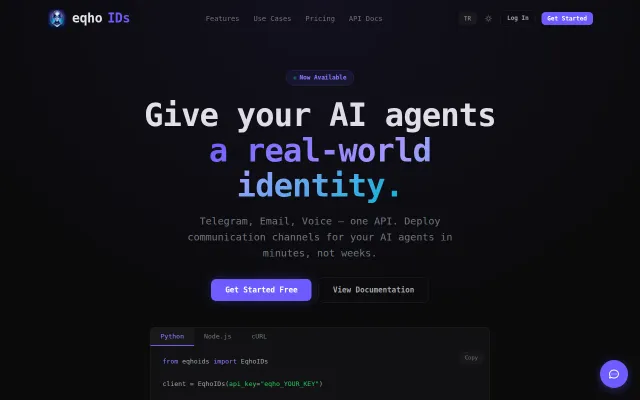
Everything you need to make an AI 'person' is packaged behind a single API key: create an agent, push messages to Telegram/email/voice, and even convert/render 3D assets — the docs and SDK snippets make the happy path extremely fast. What I want to see next are the hard details (phone provisioning, rate limits, delivery guarantees, privacy/compliance) because the UX and feature mashup are compelling, but execution will hinge on infra and policy work.