Developer Tools●Mid
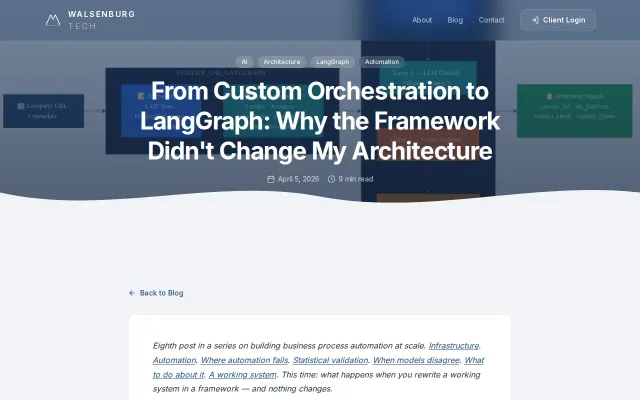
Same agentic pipeline, two implementations – custom async vs. LangGraph
Blog post analysis showing LangGraph didn't change architecture from custom async Python implementation.
Big Brain
cowartc
202mo ago
Minimal, async-first Python framework for production LLM apps- 2 hard deps, no magic, no SaaS.
LangChain alternative with 2 dependencies in an already crowded framework space.
Python developers building LLM applications and agents
LangChain · LlamaIndex · Haystack
Blog post analysis showing LangGraph didn't change architecture from custom async Python implementation.
AgentForge compresses common production patterns—token-aware rate limiting (token-bucket), retry+exponential backoff, prompt templates and cost tracking—into a tiny async core and lets you flip providers with one parameter. The multi-agent mesh and ReAct loop bits are the most interesting engineering bets here, and the repo includes benchmarks and a Streamlit demo, but it lives in a crowded space next to LangChain and similar toolkits so real differentiation will come from adoption and edge-case robustness.
Behavior-tree orchestration for agents when LangGraph and AutoGen already exist.
LangChain alternative with 2 dependencies and async-native architecture from the start.
AgentForge packs provider adapters (Claude, GPT‑4, Gemini, Perplexity), token-aware rate limiting, retry/backoff, and a MockLLMClient for tests into a tiny dependency surface — the 15KB footprint and 2 dependencies is an attention-grabber. The 3‑tier Redis cache and benchmark claims (huge latency/memory wins vs LangChain, 88% cache hit) make it a tempting low-overhead alternative, though you should validate provider feature parity and benchmarks against your workload.
Smart local‑first routing that only escalates to expensive cloud planners when necessary is the standout idea — combined with per‑run cost accounting and full Ollama offline support it solves a real operational itch. The repo is a pragmatic, CLI/TUI-focused toolkit (scraping + cache, MCP server mode) that feels useful for teams wanting a no‑friction orchestrator, but it’s playing in a crowded space of agent frameworks so the novelty is incremental rather than revolutionary.