AI/ML●●Solid
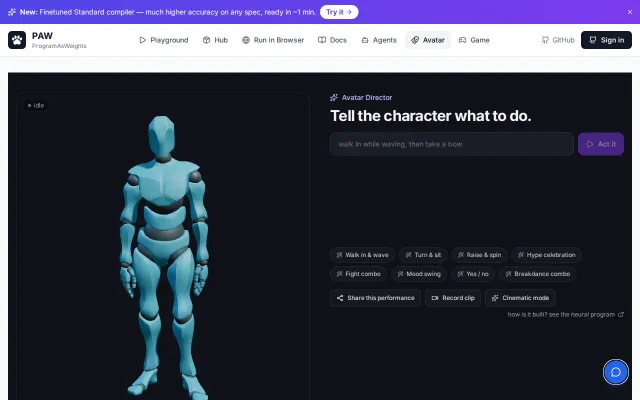
Control a 3D avatar with English instead of buttons
English-to-animation compiler beats Mixamo for natural language control.
WizardryBold Bet
cloudyclouds
511mo ago
22 MB compiled neural functions run locally — no API calls after compilation.
Developers building local-first AI features without API dependencies
Guidance · LMQL · Outlines
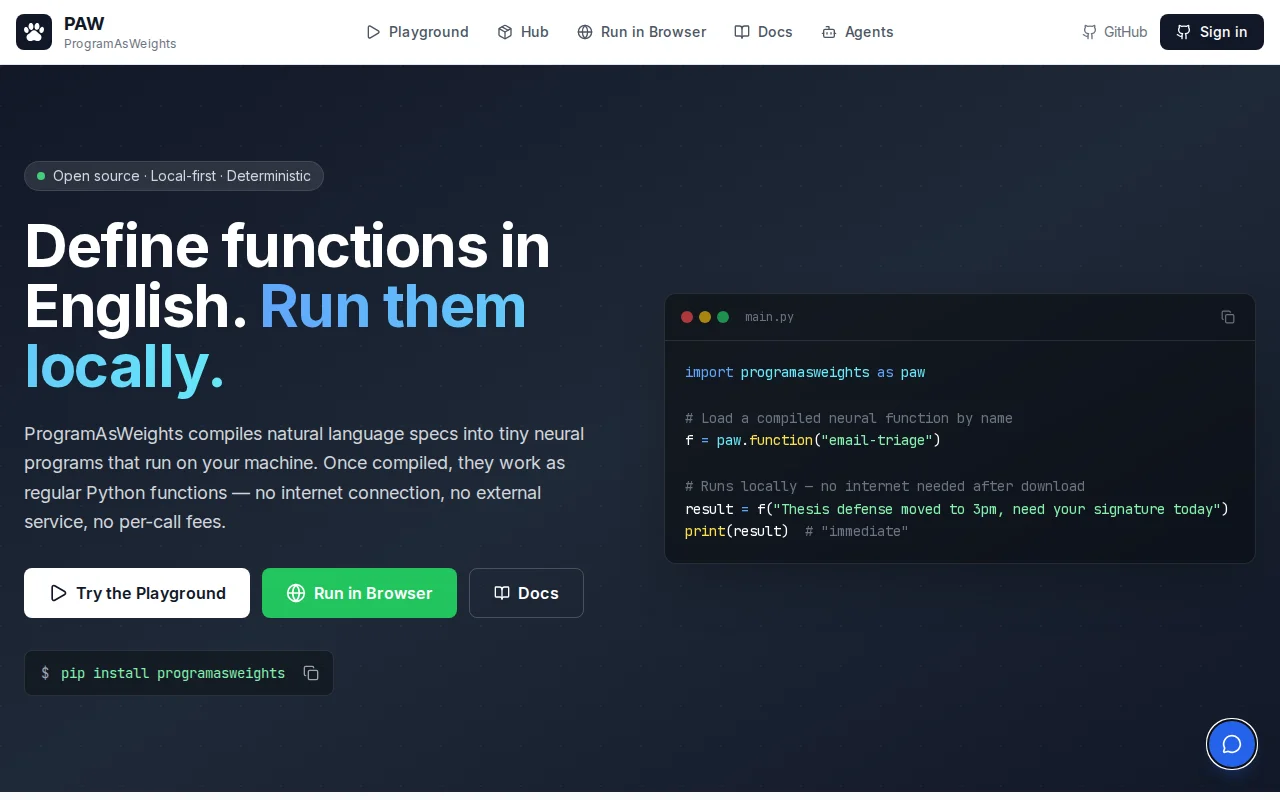
You describe a function in English — like "classify if this message is urgent" — and PAW compiles it into a tiny neural program (22 MB) that runs locally like a normal Python function. No API keys, no internet after compilation, deterministic output.
It's for tasks that are easy to describe but hard to code with rules: urgency triage, JSON repair, log filtering, tool routing for agents.
pip install programasweights
import programasweights as paw f = paw.compile_and_load("Classify if this is urgent or not.") f("Need your signature by EOD") # "urgent"
Compilation takes a few seconds on our server. After that, everything runs on your machine. Each program is a LoRA adapter + text instructions that adapt a fixed pretrained interpreter (Qwen3 0.6B). The model itself is unchanged — all task behavior comes from the compiled program.On our evaluation, this 0.6B interpreter with PAW reaches 73% accuracy. Prompting the same 0.6B directly gets 10%. Even prompting Qwen3 32B only gets 69%.
Also runs in the browser (GPT-2 124M, WebAssembly): https://programasweights.com/browser
You can also use it in your AI agents by copying the prompt here: https://programasweights.com/agents
Source: https://github.com/programasweights
Try it out: https://programasweights.com
English-to-animation compiler beats Mixamo for natural language control.
Natural language to code via LLM when Claude Code already does this.
Self-hosting Miranda dialect compiler in 7kloc with 19-pass optimization and GC.
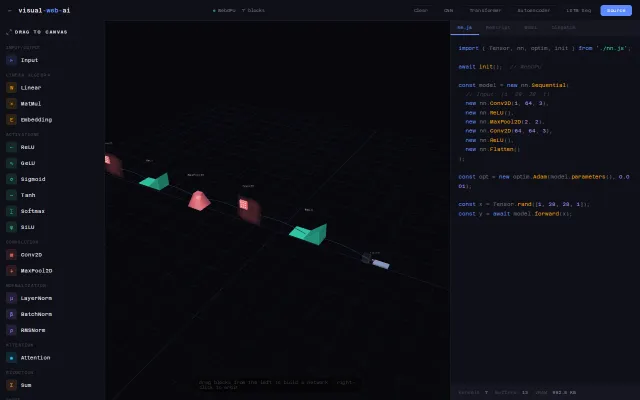
Drag-and-drop network canvas with live WebGPU execution and generated nn.js/WGSL snippets — you can assemble Conv2D→ReLU→MaxPool chains, run a forward pass, and watch kernels/buffers/VRAM stats update. The fact it compiles layers down to WGSL and executes in-browser is a neat technical win, and the 3D node UX actually helps reason about topology. Lacking clear training support, ONNX/TFJS interchange, or stability guarantees, it's strongest as an exploratory tool and demo platform.
Twenty-year-old compiler tech reborn as JIT for Postgres native code execution.
Built-in DI and decision tables are novel, but another language needs more than features.