Infrastructure●●●Banger
Pyre Agents – An Elixir-Orchestrated Runtime for Python Agents
Uses Elixir OTP to orchestrate Python agents with 3.77 KB memory overhead.
Big BrainWizardryNiche Gem
KashyapArjun
302mo ago
Config-driven engine that turns JSON into production-grade AI agents. Multi-agent orchestration, 12+ LLM providers, MCP/A2A protocols, RAG, persistent memory, and enterprise compliance (EU AI Act, GDPR, HIPAA). Built on Quarkus.
JSON-configured agents with cascading model selection and EU AI Act compliance.
Enterprise teams needing compliant, auditable AI agents
LangGraph · CrewAI · AutoGen
My answer was: agent logic belongs in JSON configs, not code. You describe what an agent should do, which LLM to use, what tools it can call, how it should behave. The engine reads that config and runs it. No dynamic code execution, ever. The LLM cannot run arbitrary code by design. The engine is strict so the AI can be creative.
v6 is the version where this actually became practical. You can have groups of agents debating a topic in five different orchestration styles (round table, peer review, devil's advocate...). Each agent can use a different model. A cascading system tries cheap models first and only escalates to expensive ones when confidence is low.
It also implements MCP as both server and client, so you can control EDDI from Claude Desktop or Cursor. And Google's A2A protocol for agents discovering each other across platforms.
The whole thing runs in Java 25 on Quarkus, ships as a single Docker image, and installs with one command. Open source since 2017, Apache 2.0.
Would love to hear thoughts on the architecture and feature set. And if you have ideas for what's missing or what you'd want from a system like this, I'm all ears. Always looking for good input on the roadmap.
Uses Elixir OTP to orchestrate Python agents with 3.77 KB memory overhead.
Claude orchestration with live dashboards and agent-spawning—well-built but competes with Anthropic, OpenAI infrastructure.
Another no-code agent builder competing with Langflow and Dify in a saturated market.
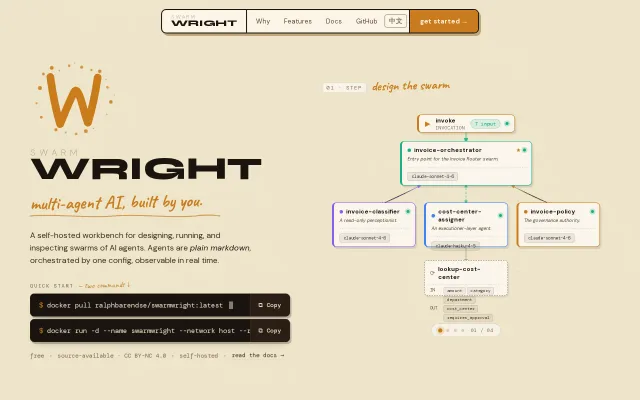
Markdown-defined agents with enforced topology—finally structured autonomy that compliance can approve.
Iteratively improves agent harnesses from 67% to 87% on tau-bench using production traces.
Replaces tmux chaos with visual agent orchestration—dependency graphs, live monitoring, verification queue.