Developer Tools●●Solid
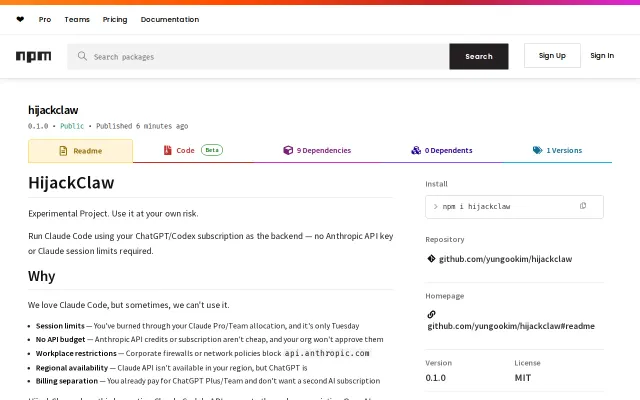
Claude-codex-proxy – Use Claude Code with ChatGPT subscription
Run Claude Code CLI with ChatGPT subscription, bypassing Anthropic's tighter usage limits.
Big BrainNiche Gem
rane
701mo ago
Production-ready LLM API translation layer for Python — bidirectional conversion between OpenAI, Anthropic & Google formats via hub-and-spoke IR. Optional API gateway. Streaming & non-streaming. Zero core deps. Contributions welcome!
Hub-and-spoke IR translates LLM APIs without N^2 adapter hell.
Backend engineers building multi-provider LLM applications
LiteLLM · LangChain · Portkey
The idea is to translate through a shared intermediate representation instead of writing every provider pair separately. So instead of OpenAI->Anthropic, OpenAI->Gemini, Anthropic->Gemini, etc., each provider just maps to/from the IR.
This is not a unified client like LiteLLM. It's a translator/proxy: give it an OpenAI-style request and it can produce the Anthropic/Gemini equivalent, including streaming, tool calls, and multimodal inputs.
It's open source, and there's also a gateway mode if you want to run it as a proxy in front of multiple providers.
Would especially love feedback on where translation breaks down or gets too lossy across providers.
Docs: https://llm-rosetta.readthedocs.io Paper/design notes: https://arxiv.org/abs/2604.09360
Run Claude Code CLI with ChatGPT subscription, bypassing Anthropic's tighter usage limits.
Clever protocol translation, but routing around Anthropic's ToS is a hard limit.
Unified API gateway for Ollama + vLLM with real-time GPU telemetry and drain mode.
Multi-provider cost dashboard when LangFuse and Helicone already do this.
The actual product is a prompt—functional wrapper but nothing novel.
Stripped-down Portkey fork handling protocol translation for 77 providers without enterprise bloat.