AI/ML●Mid
An Open-source platform for building and orchestrating AI agents
Agent orchestration platform when LangGraph, CrewAI, and AutoGen already exist.
Ship It
sup3rus3r_git
113mo ago
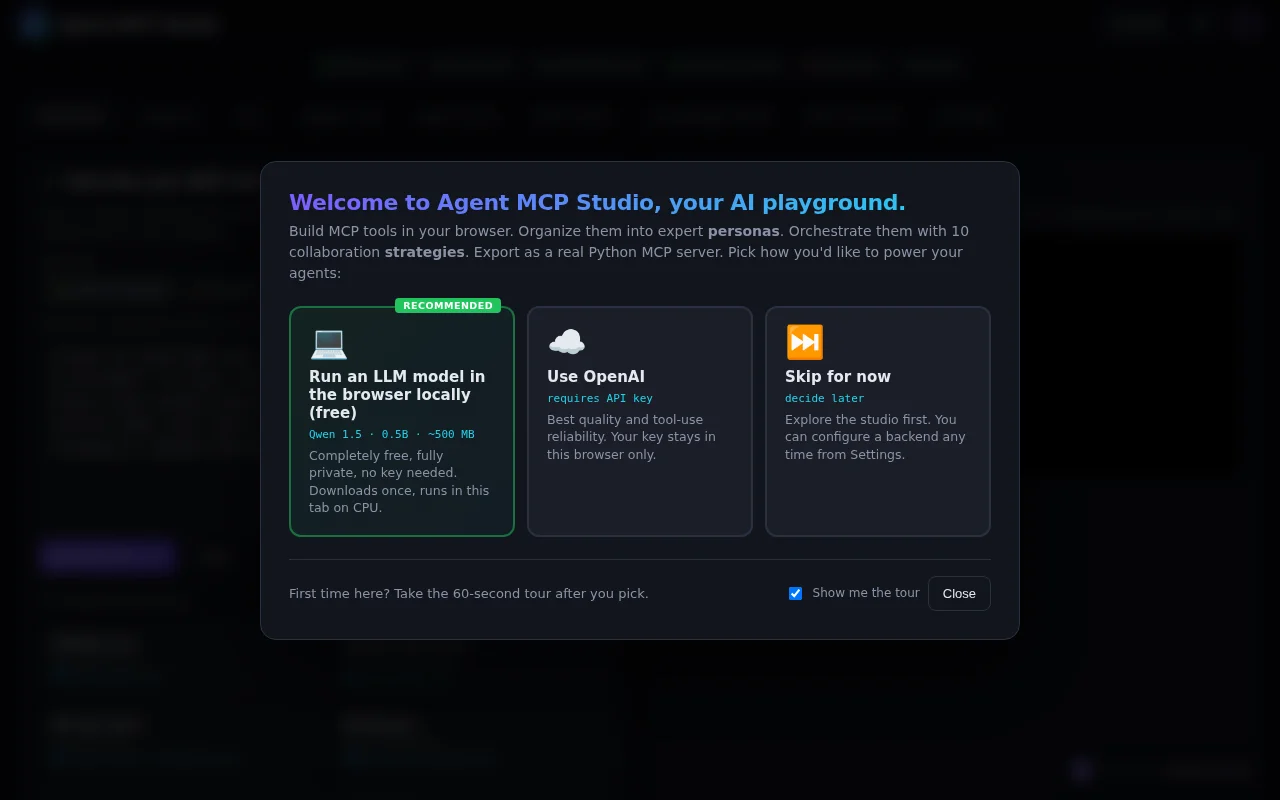
Full MCP agent studio running entirely in-browser via Pyodide and DuckDB-WASM.
AI engineers and developers experimenting with MCP agents
LangChain · CrewAI · Dify
The bet: WASM is a hard sandbox for free. When you generate tools with an LLM (or write them by hand), the studio AST-validates the source, registers it lazily, and JIT-compiles into Pyodide on first call. SQL tools run in DuckDB-WASM in a Web Worker. The built-in RAG uses Xenova/all-MiniLM-L6-v2 via Transformers.js for on-device embeddings. Nothing leaves the browser; close the tab and the stack is gone. The WASM boundary is what makes it safe to execute LLM-generated code locally — no Docker, no per-tenant container, no server.
Above the tool layer sits an agentic system with 10 orchestration strategies:
- Supervisor (router → 1 expert) - Mixture of Experts (parallel + synthesizer) - Sequential Pipeline - Plan & Execute (planner decomposes, workers execute) - Swarm (peer handoffs) - Debate (contestants + judge) - Reflection (actor + critic loop) - Hierarchical (manager delegates via ask_<persona> tools) - Round-Robin (panel + moderator) - Map-Reduce (splitter → parallel → aggregator)
You build a team visually: drag tool chips onto persona nodes on a service graph, pick a strategy, and the topology reshapes to match. Each persona auto-registers as an MCP tool (ask_<name>), plus an agent_chat(query, strategy?) meta tool. A bundled Node bridge speaks stdio to Claude Desktop and WebSocket to your tab — your browser becomes an MCP server.
When you're done, Export gives you a real Python MCP server: server.py, agentic.py, tools/*.py, Dockerfile, requirements.txt, .env.example. The exported agentic.py is a faithful Python port of the same orchestration logic running in the browser, so the deployable artifact behaves identically to the prototype.
Also shipped: Project Packs. Export the whole project as a single .agentpack.json. Auto-detects required external services (OpenAI, GitHub, Stripe, Anthropic, Slack, Notion, Linear, etc.) by scanning tool source for os.environ.get(...) and cross-referencing against the network allowlist. Recipients get an import wizard that prompts for credentials. Manifests are reviewable, sharable, and never carry secrets.
Some things I'm honestly uncertain about:
- 10 strategies might be too many. My guess is most users only need Supervisor, Mixture of Experts, and Debate. Open to data on which ones actually pull weight. - Browser cold-starts (Pyodide warm-up on first load) are a real UX hit despite aggressive caching. - bridge.js is the only non-browser piece. A hosted variant is the obvious next step.
Built with Pyodide, DuckDB-WASM, Transformers.js, OpenAI Chat Completions (or a local Qwen 1.5 0.5B running in-browser via Transformers for fully offline mode). ~5K lines of HTML/CSS/JS in one file.
Genuinely curious whether running this much LLM-generated code in a browser tab feels reasonable to you, or quietly terrifying.
Agent orchestration platform when LangGraph, CrewAI, and AutoGen already exist.
MCP orchestration framework removes agent glue code, but competes with nascent LLM infra tooling.
Another MCP orchestration wrapper—claims autonomy, but chaining APIs over Docker isn't novel.
Pyodide-powered browser IDE with 500+ gallery examples and one-click Android APK export.
It makes a smart, practical bet: let existing Python functions become agent-ready tools by turning type hints into structured tool schemas with validation and HTTP endpoints, so you don't rewrite logic to expose it to agents. The included PolyClaw agent and discovery/orchestration features sound useful for multi-service workflows, but the space is crowded (LangChain/AutoGPT/etc.), so what matters next is demos showing robust orchestration, failure handling, and provider integrations.
MCP agent orchestration framework, but MCP itself is still early and fractured.