Developer Tools●●Solid
Agile V Skills – Open skills for verifiable, traceable AI engineering
Enforces test independence in AI agents to break the confirmation bias loop.
Big BrainBold Bet
JoshuaWellbrock
203mo ago
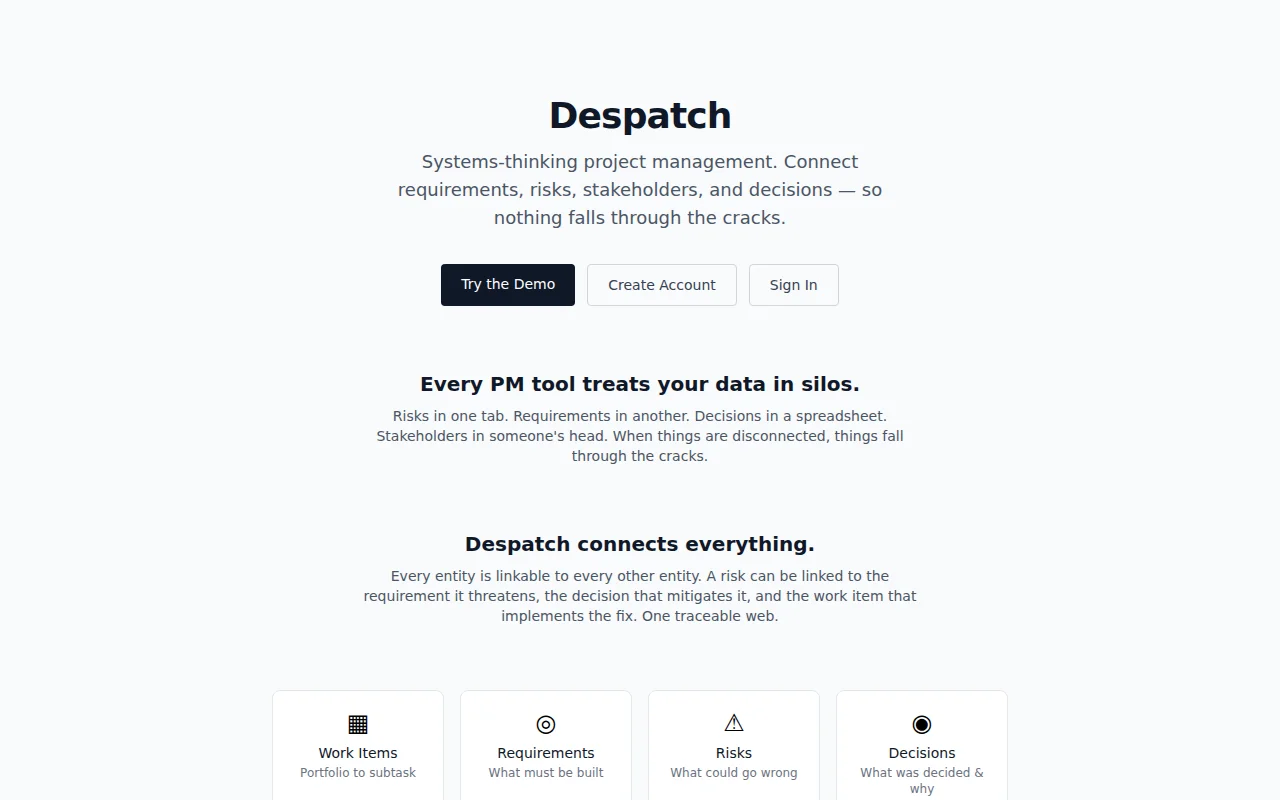
Native requirements traceability beats duct-taping spreadsheets to Jira.
Systems engineers, government contractors, infrastructure project managers
Jama Connect · IBM DOORS · Helix ALM
These fields have deep hierarchy (programmes → projects → work packages → tasks), and need first-class data structures for requirements, stakeholders, interfaces, and risk registers — not just tickets and sprints.
Existing mainstream tools either force you into a flat task-board model or make you duct-tape spreadsheets and CRMs together.
Despatch has a native systems-thinking data model: requirements traceability, stakeholder registers, and multi-level programme structure out of the box.
The demo includes an MCP-based conversational interface — describe your programme and it builds the structure for you.
Would love feedback from anyone in defence, government, infrastructure, or any field where you've outgrown generic PM tools and have been forced back to first principles spreadsheets.
Enforces test independence in AI agents to break the confirmation bias loop.
Avoids LLM hallucination with deterministic scoring, but a pros/cons spreadsheet solves the same problem.
Zero-setup Jira analytics that parses changelogs instead of requiring custom fields.
Verifiable decision memos, not just AI answers—but adoption depends on enterprise sales, not product uniqueness.
ESLint for your thinking: Claude plugin that scores decision assumptions.
The demo implements post-generation admissibility checks and returns structured refusals (decision codes, rule triggered, divergence metrics and a stable prompt fingerprint) so you can audit enforcement decisions. It's a crisp, focused proof-of-concept for runtime enforcement — useful as a starting pattern — but it stops short of addressing bypass/adversarial vectors, deployment integration, or guarantees that make it enforceable at scale.