Developer Tools●●Solid
Loom: A Compiler for Agentic Workflows (Go, Python, Rust)
Compile-time validation catches broken agent transitions before runtime.
Big BrainZero to One
thecartine
112mo ago
Workflow-enforced AI agents. Paragraph in, graph out, snap-back on deviation.
Compiles English paragraphs into workflow graphs that block destructive agent actions.
Developers deploying autonomous AI agents with access to sensitive tools
LangGuard · ProtectAI
BetterClaw takes a different angle: you describe the workflow you want in plain English ("Diagnose the credential mismatch - read the config, test the connection, report findings — do not modify or delete anything"), and the CLI compiles that paragraph into a directed graph of nodes, where each node declares which tools are allowed at that step. A plugin hooks into your agent's tool-call path and blocks anything outside the graph before it dispatches to the MCP server.
So in the PocketOS reproducer (included in the repo with a mock Railway server, so you can run it without an account): the agent tries railway_delete_volume mid-conversation, the hook returns a deviation error, the volume is never touched.
What I'd love feedback on:
- Is "paragraph -> graph" the right authoring model, or should this be YAML / a DSL? - Where does this fall down for you? (Multi-step approvals? Loops? Sub-agents?) - What other agent runtimes should we support beyond Claude Code + Cowork + OpenClaw?
Repo: https://github.com/jfan22/BetterClawDemo (90s): https://youtu.be/ZreUtANHET0?si=VpdjA6lf0Wa1mhoi
Install: npm install -g @betterclaw-ai/cli
Apache 2.0.
Compile-time validation catches broken agent transitions before runtime.
Compiles rejected runs into markdown lessons so the next planner avoids same mistakes.
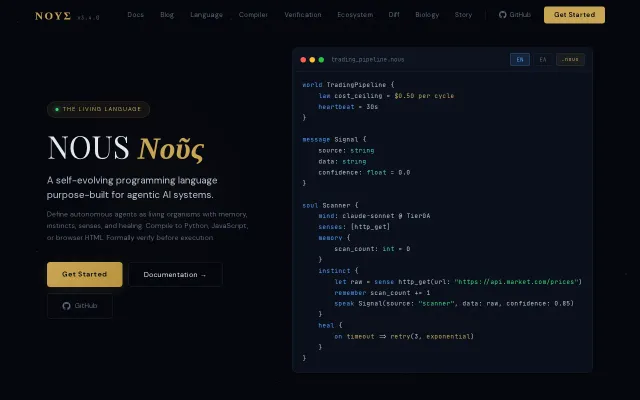
Formal verification for AI agents before compilation, unlike LangChain or AutoGen.
GNN predicts circuit optimization then explains results in research-grade prose.
Runtime-owned state with recovery rules for agent workflows that outlive a single session.
DSL approach beats LangGraph's Python boilerplate for reviewable workflows.