Developer Tools●Mid
Design to Code
Yet another Figma-to-code tool when Anima and Builder.io already exist.
Eye CandySlick
absolute7
642mo ago
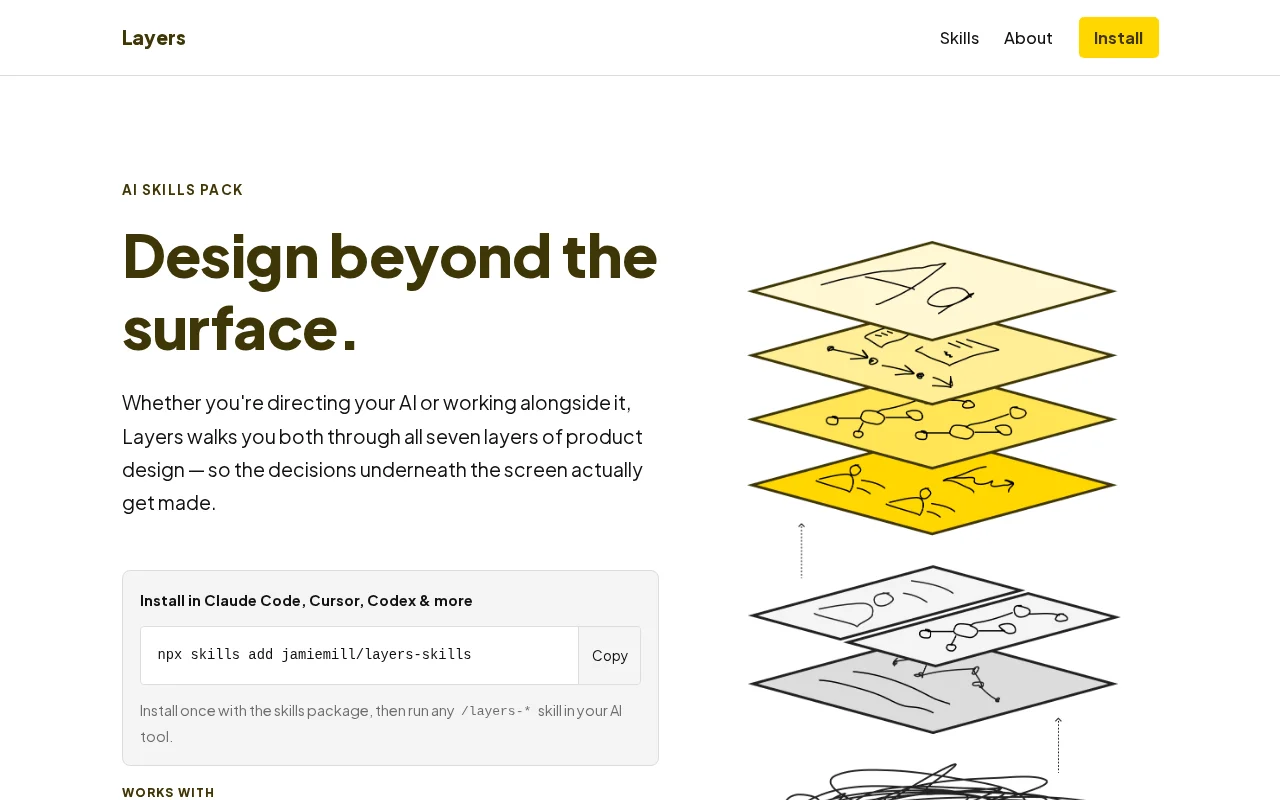
Forces AI to output strategy maps and job stories instead of just generating UI mockups.
Product designers, UX researchers, and product managers using AI coding assistants
Design System generators · Generic UX prompt libraries
The framework seems to help remind designers and their teams that there's more to design than just the visuals: structure and flow, concept modelling, product strategy, domain understanding, user needs.
What's lacking from the article are concrete steps how you might apply the thinking, which was always a bit hard because it's so situational. But with AI, I felt suspected I could give it examples and guidance about each layer and use the LLM's creativity to fill in the blanks.
The result is a set of skills, one per layer, plus an 'Orient' skill to help kick things off.
The idea is to use it as a coach, a sparring partner, or if you're delegating design to AI, to tell it to use the skills to ground the design in the necessary deeper work.
It works quote well in Claude Code, asking it to write to Markdown files, which I view in VS Code with the 'Markdown Preview Mermaid Support' extension.
I tried asking with Figma MCP asking it to diagram in FigJam but the labels overlapped and it wasn't readable. ;( That would be a good next step so you can take over and edit the diagrams more easily, if anyone has some ideas.
Yet another Figma-to-code tool when Anima and Builder.io already exist.
Design system specs for agentic code — but LLMs already constrain via prompts.
Organized Go best practices for agents, but it's markdown files like any custom instruction.
Solves workflow fragmentation across AGENTS.md, .cursor/rules, and scattered scripts.
Curated list of prompt files for a specific AI tool, nothing more.
VERONICA puts an enforcement shim between your agent and the model so you can halt costly spirals before a request hits the provider — it natively exposes hard budget enforcement, circuit breakers, retry containment and degradation levels. The README + runnable runaway-loop demo make the failure mode concrete and the API (BudgetEnforcer, RuntimeContext, BudgetExceeded) is small and practical. I'd like to see richer observability/adapter docs for common agent frameworks, but as an enforcement-first primitive this is a clever, useful tool.