Health●●Solid
How Are You-elderly fall detection app I built solo with AI in 6 months
Behavior-based anomaly detection beats simple accelerometer fall detection.
Solve My ProblemShip It
sminchev
4103mo ago
Passive monitoring for seniors who refuse wearables, but Android-only limits reach.
Adult children caring for aging parents
CarePredict · GrandCare · Lively
My wife's grandfather had his health issues and all were concerned about him.
And now my parents. What if something happens to them? How will I know? How can I help, when I am not around, with two kids. What can I do about it?
And I know my father. He will not carry a smart watch, he will not call me, he will not like being watched by a camera.
What if he can't pick up the phone and call me?
And I don't see such software on the market, that you install on his device, and it stays passively there, not bothering him for anything. Just monitoring there, quietly.
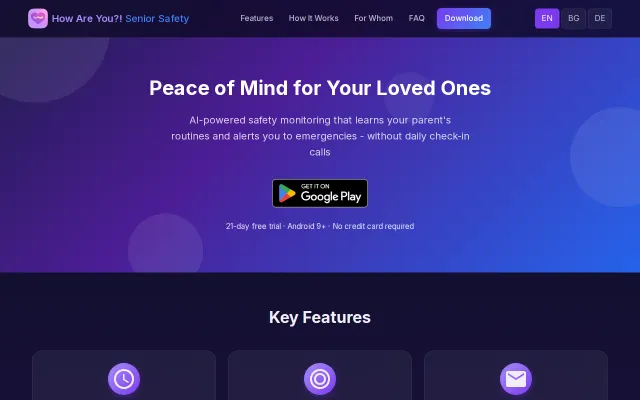
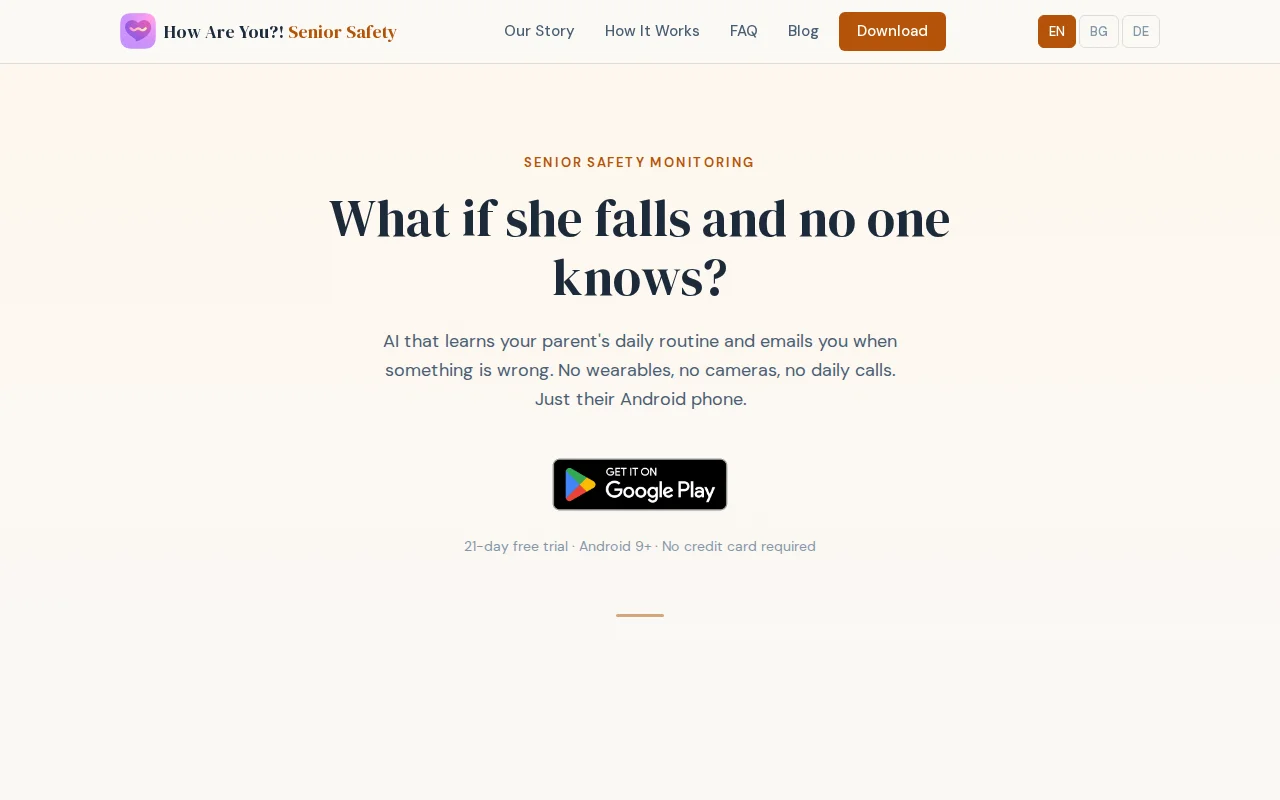
I tried to make this application up and running. With modern technologies, this is possible. The application monitors and updated regularly the patterns of sleep, activeness, and rests. Searches frequently visited places, and if detects something might be wrong, it sends me notification.
For example:
* My father is usually has a daily walk between 7AM and 11AM. If he does not do it, he might have fall, and I will receive a notification;
* He usually have a rest between 14:00 PM and 16:00PM. If the rest goes too long, I will be notified;
* If he is still on an unknown place for a long time, I will get notified.
There are still cases that I follow and resolve, but this is how it is, with software. It requires dedication and support. And I really want to support this and make the product better and better!
It is free the first 21 days, so that people can see if this works for them. Afterwards, I wanted to keep it cheap: $49 annual subscription for the first year, and $5 subscription for each next one. I have some expenses that I need to cover.
I don't do it about the money, I just want to help people, learn new things, and take the whole journey. The journey is more important about the money, for me.
From technical perspective, the biggest challenge was to keep at app alive. Every Android based OS has its own way to detect for an app that runs and does too much: * At night, android enters doze mode and all dies;
* If the app is not opened for a few weeks, some permissions are silently removed;
* If the OS updates itself - some permissions might be silently removed;
* If the app does some extreme usage, especially for newly installed apps, it gets flagged, and it might revoke some configurations like 'disable battery optimizations';
It was a nightmare. I think I covered a lot of cases, and I also implemented an application health check monitoring, so that if something like that happens, to be able to notify the people, to set again the silently removed permissions.
I am writing to different communities, asking for help and support. I need feedback. Honest people to install it, and check if that works for them, what else should I add so that it gets better, and do its job perfectly.
Even though it is hard to convince people, I don't want this to be treat as promotion. I would like this to be treated as a request, to do good things for our well-deserved parents and relatives.
Thank you!
Behavior-based anomaly detection beats simple accelerometer fall detection.
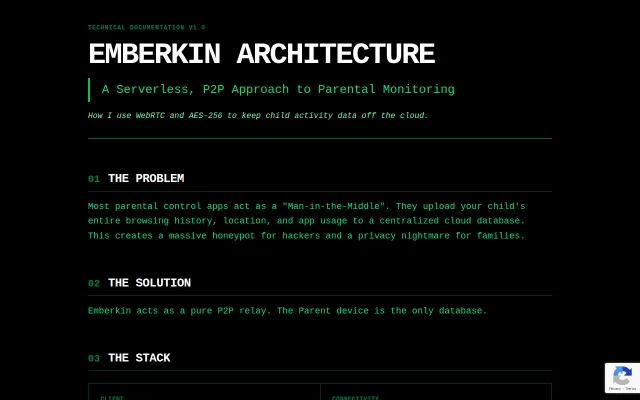
Routing all activity through a WebRTC data channel with NSD pairing so the parent device is the only database is a smart, not-obvious counter to the usual cloud-heavy parental-control model. The stack reads like someone who actually built this: ECDH handshakes, AES-256-GCM payloads, TURN fallback and minimal Firebase signaling. That said, 'custom implementation' of AES plus the app's reliance on Accessibility/Usage permissions are serious trust points — open-source crypto and an external audit are must-haves before you hand over sensitive data.
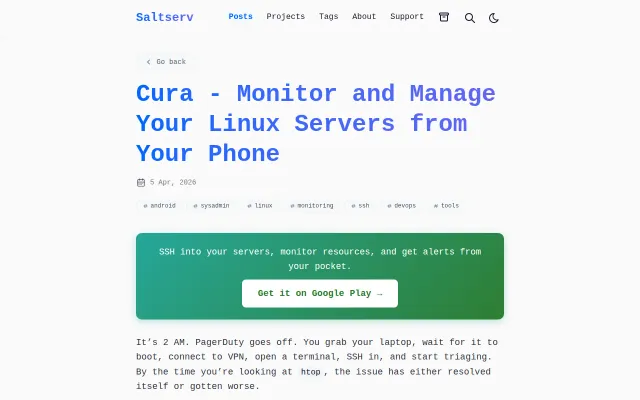
Android SSH client with built-in runbooks and resource monitoring for on-call triage.
Clean quota dashboard on Android, but macOS-first CodexBar already fills this niche.
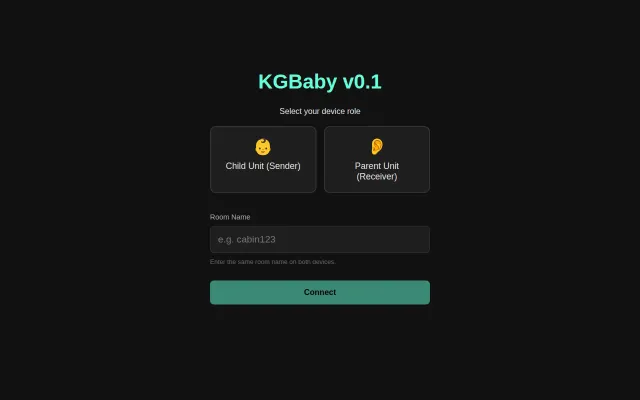
The project nails a practical niche: zero-latency P2P audio via WebRTC with PeerJS signaling so your stream never routes through a cloud service. The clever (if hacky) hidden 1x1 base64 looping video to keep Mobile Safari's microphone alive shows someone dug into platform quirks — useful and real-world, but also a reminder this is an MVP with battery and backgrounding tradeoffs.
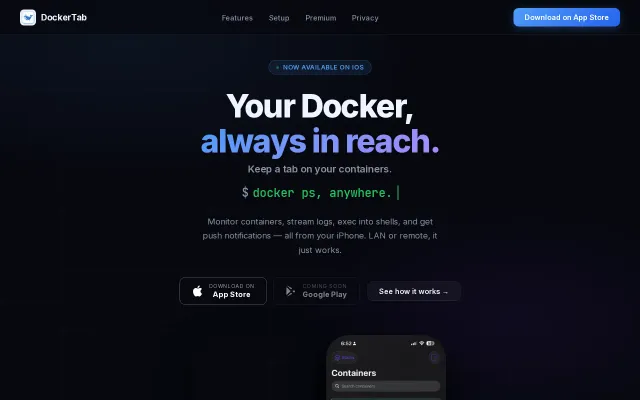
Native mobile Docker client with secure relay beats SSH-ing through Termius on phone.