Productivity●●Solid
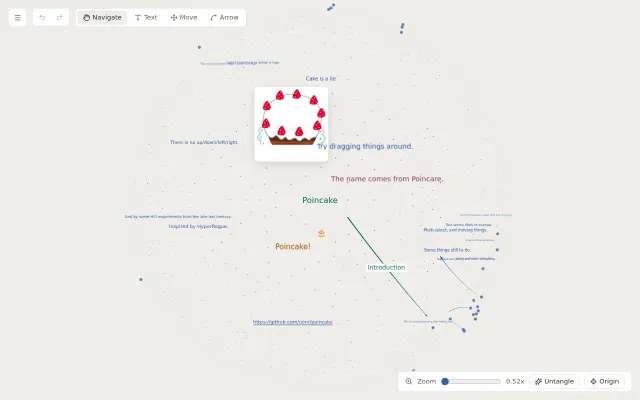
Infinite canvas notes in the non-Euclidean Poincaré disk
Hyperbolic geometry note-taking demo with Poincaré disk visualization, but controls need work.
Rabbit HoleWizardryBold Bet
uonr
1883313d ago
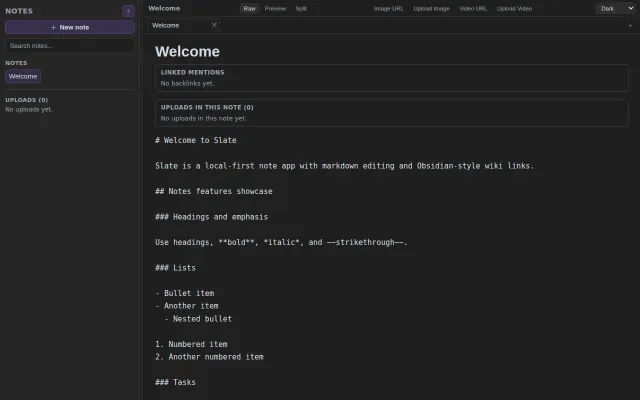
Extensible inline-markdown editor with wiki-style navigation
Obsidian-style wikilinks as an embeddable SDK, but the notes canvas space is packed.
Developers building custom note-taking apps or documentation sites
Obsidian · Logseq · Foam
I was inspired by a demo of a digital art canvas that kept revealing gem after gem. I wanted to apply that concept to a website via a text editor. I've used obsidian for note-taking for a while now, and while appreciate it's publish feature, I wanted to take a swing at making a website with markdown based back-end.
The worldnotes SDK has: - Markdown based notes, compatible with Obsidian or other markdown based editors that support wikilinks. - Lean editor core (just the basics to get you going) - Plugin system to extend editor capabilities - Full theming support via CSS tokens - easy to make your own - Ability to create custom storage adapters to serve content however you like
You can checkout a demo here: (all changes are local) https://worldnotes.alexmason.me
Disclaimer: AI was used in development - it's okay. The code won't hurt you.
Hyperbolic geometry note-taking demo with Poincaré disk visualization, but controls need work.
Beautiful 'quiet software' philosophy, but another AI note app in a saturated market.
Spatial canvas instead of lists, but Miro, Notion, and Linear already own this problem space.
Infinite canvas for terminals and editors when tiling window managers already exist.
Another infinite canvas tool competing with Notion, Miro, and Heptabase without clear differentiation.
Rust-built local notes app in crowded space with no differentiator versus Obsidian.