Productivity●Mid
Worldnotes – infinite notes in-browser canvas
Obsidian-style wikilinks as an embeddable SDK, but the notes canvas space is packed.
Ship ItNiche Gem
recursivegirth
2010d ago
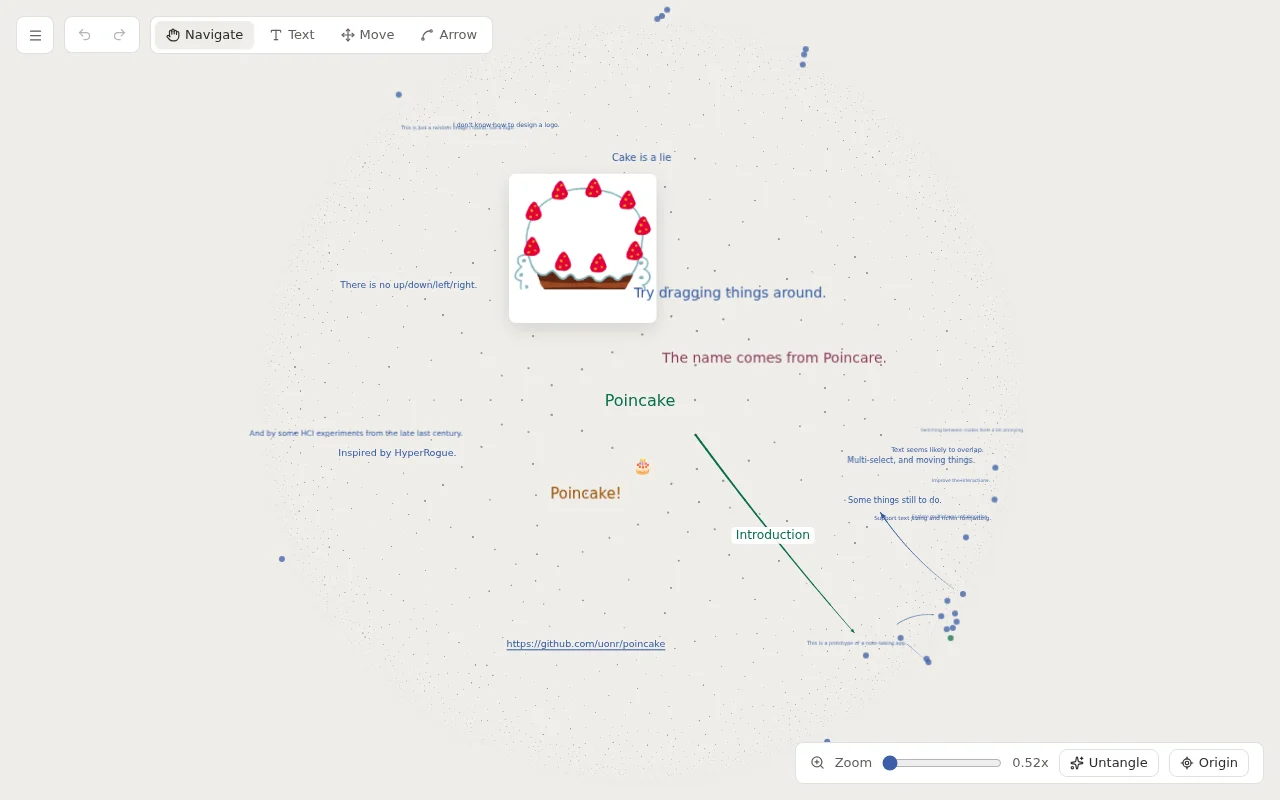
Hyperbolic geometry note-taking demo with Poincaré disk visualization, but controls need work.
Knowledge workers, note-taking enthusiasts, HCI researchers
Obsidian Canvas · Heptabase · Hyperbolic Tree browsers
This is an infinite canvas note-taking tool where notes are laid out in a non-Euclidean, hyperbolic geometric space. As you drag and navigate through the view, you’ll experience a unique fluid distortion that naturally leverages your brain's spatial memory.
I’ve been obsessed with the concept of space in HCI for years. Many modern UI patterns are essentially workarounds for the lack of screen real estate. While researching zoom-based UIs a while back, I stumbled upon old HCI papers that used the Poincaré disk model of the hyperbolic plane to organize data. It elegantly projects an infinite space into a finite disk, keeping everything contextually visible.
I wanted to build an experimental app around this concept years ago, but the non-Euclidean math was a significant roadblock. Recently, I decided to give it a shot with the help of LLMs. It turns out that LLMs can handle the mathematical heavy lifting quite well, specifically in designing the coordinate systems and optimization algorithms, provided that you guide them with a solid architectural design.
This is still an experimental demo, but I hope it leaves an impression. I’d love to know if you find this paradigm practical for organizing your thoughts.
Obsidian-style wikilinks as an embeddable SDK, but the notes canvas space is packed.
Beautiful 'quiet software' philosophy, but another AI note app in a saturated market.
Spatial canvas instead of lists, but Miro, Notion, and Linear already own this problem space.
Yet another AI notes app competing with Notion, Obsidian, and Mem without clear differentiation.
Unnamed drafts and automatic resurfacing are the two gutsy choices here — start writing and the app tries to pull up related notes for you. It's a neat UX shortcut if the semantic matching is strong, but the landing page hides how recall is implemented (model, privacy, offline), and in a crowded space with Mem/Reflect clones that detail matters.
Local-first AES encryption notes, but crowded space with Obsidian, Notion, Logseq alternatives.