Developer Tools●●Solid
Photon – Rust pipeline that embeds/tags/hashes images locally w SigLIP
Local SigLIP embeddings + 68K-term semantic tagging in a single Rust binary, zero cloud.
WizardryNiche GemShip It
pgbouncer
313mo ago
Speaker diarization in Rust. 312–912x realtime on Apple Silicon, 50–121x on CUDA. Matches pyannote accuracy.
CoreML-powered diarization that's 37x faster than pyannote on Apple Silicon.
ML engineers and audio developers working with speaker diarization on macOS
pyannote.audio · NVIDIA NeMo · AWS Transcribe
There is no Python runtime in the library path. Inference runs on ONNX Runtime or native CoreML, and the rest of the pipeline stays in Rust.
It is 20x-30x faster on macOS, but only 2-3x faster on linux/cuda (depending on CPU).
Few reasons its faster:
1. Speakrs is using coreml versions of the models. I exported the models specifically to run on coreml. PyAnnote just runs the same the same PyTorch versions through MPS (Metal) on macOS.
2. PyAnnote is not a single model, its a few different models put together in a pipeline, the readme has some info on the full pipeline.
3. Speakrs optimizes the pipeline so different parts can run on CPU, Neural Engine and GPU. Speakrs has a batch mode, where you can run on multiple files at once, doing this also lets you keep CPU/GPU/ANE all fully utilized.
This is why on linux/cuda its not that much faster, PyAnnotate is already optimized to run on cuda, the speed improvements we get on cuda is by running some stuff on cpu while the other stuff runs on the GPU. The speedup on linux will depend on how powerful the CPU is.
There is also a fast mode, that sacrifices some speed for accuracy, that can be up to 50x faster, and for some types of audio doesn't sacrifice that much accuracy. The benchmarks have more info on this.
Local SigLIP embeddings + 68K-term semantic tagging in a single Rust binary, zero cloud.
Compile-time pipeline maps for Rust, but author says don't ship it yet.
Backpressured pipeline with 60-80% dedup savings beats chatty multi-agent frameworks.
Wire-protocol proxy means zero code changes to existing LLM clients.
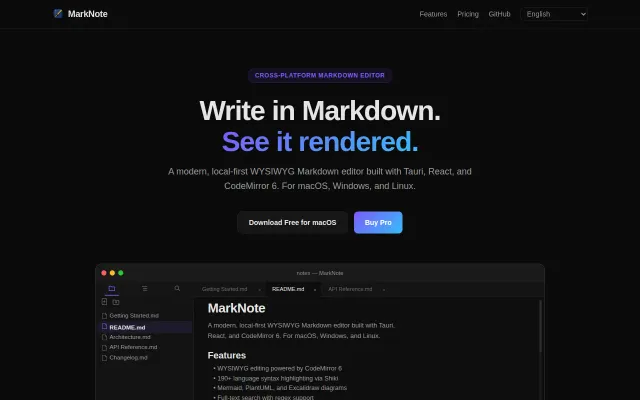
Typora alternative with Excalidraw, no subscription, but CodeMirror 6 WYSIWYG editors exist.
Post-deployment monitoring fills gap that Slither and Mythril leave open for live chains.