Security●●Solid
Zahosts Health – An open-source WHM plugin to catch /24 brute-force
/24 subnet brute-force detection is a specific security feature WHM lacks.
Niche GemSolve My Problem
MNawareg
2026d ago
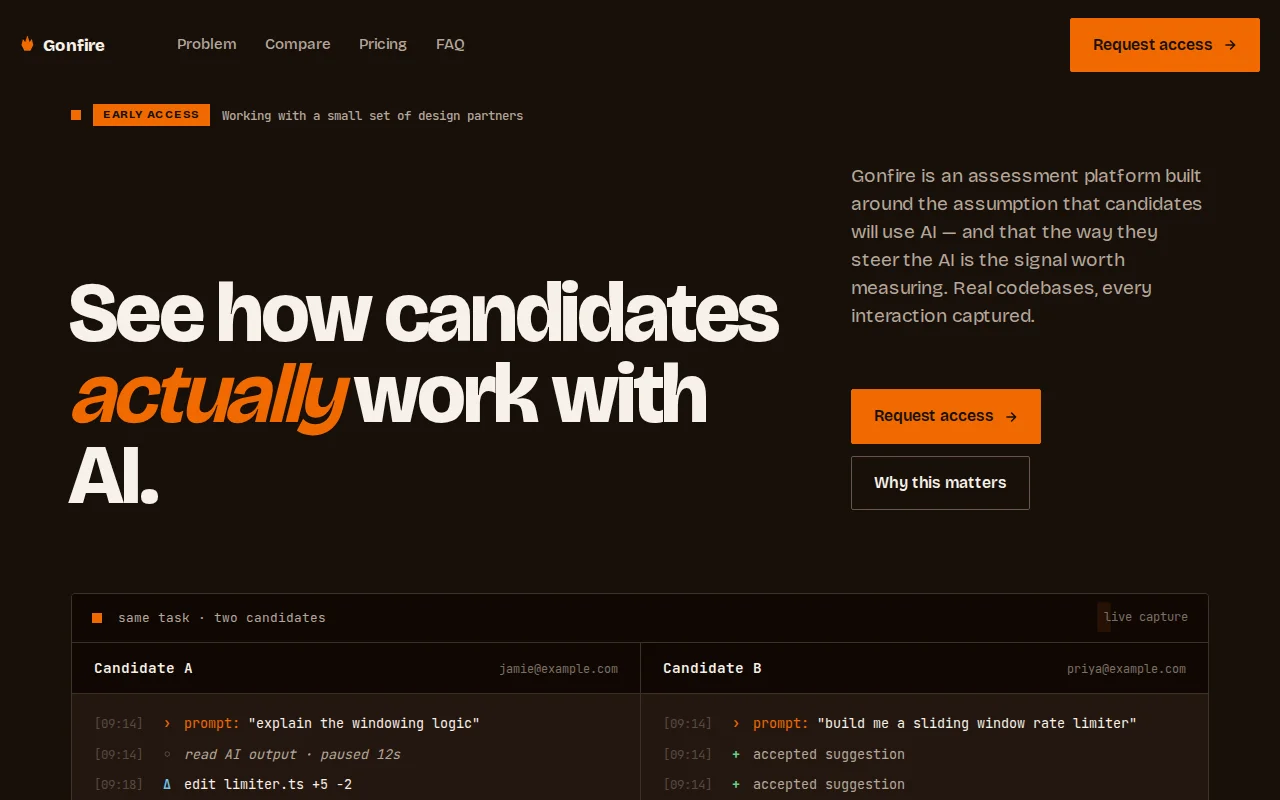
Steers AI toward naive solutions so candidate skill actually matters again.
Engineering hiring managers, technical recruiters
HackerRank · CodeSignal · Take-home assessments
A key issue with this seems to be that smarter AI models (like Opus 4.6) end up spoiling key insights of the problem by helping them too much with system design and ideation.
I set up an assessment platform which basically serves as a middle-man proxy to record all requests between Claude Code and the Anthropic endpoint.
I've recently been experimenting with a feature which prevents Opus-class models from providing too much insight by instead making sure that the LLM's suggestions are geared towards only naive and brute-force problem insights unless explicitly challenged. This should prevent increasingly intelligent models from collapsing the resolution of signal that would normally be obtained from such an assessment.
Live demo: https://app.gonfire.io ([email protected] / Aa123123123123)
/24 subnet brute-force detection is a specific security feature WHM lacks.
TPM-like lifetime attempt caps in ~360 lines of vanilla JS and PHP.
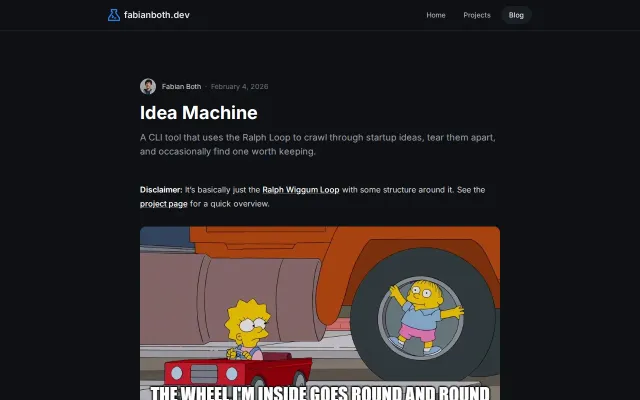
The core trick is simple and effective: let an agent iterate questions against a defined domain overnight and surface hundreds of candidly-annotated ideas you can scan through later. It nails the “fire-and-forget” idea dump and domain steering (tell it to focus on agencies or cybersecurity and it pivots), but it’s still essentially a convenience wrapper around an existing agent pattern — useful for volume and pattern recognition, less convincing on long-term validation or downstream filtering.
FortiGate honeypot with counter-intel credential tracking and VT/OTX reporting.
Go-based wordlist generator competing with Crunch and CUPP in a crowded security space.
Another wordlist generator when Crunch, CUPP, and Hashcat already dominate this space.