Developer Tools●●Solid
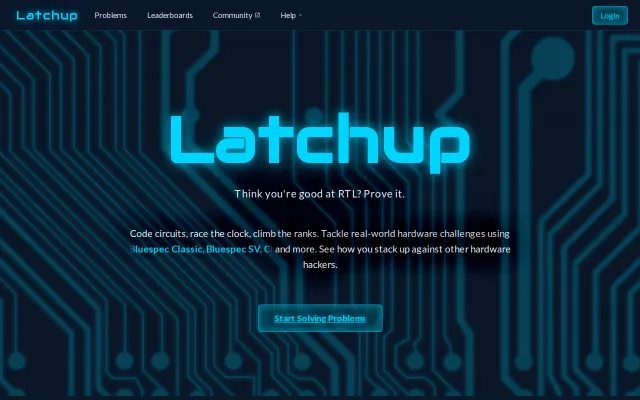
Latchup – Competitive programming for hardware description languages
LeetCode for RTL engineers with browser-based synthesis and 15+ HDL languages.
Niche Gem
fayalalebrun
204mo ago
TypeScript HDL in browser with npm testbenches—Chisel and Amaranth require heavy toolchains.
Hardware developers, FPGA engineers, embedded systems programmers
Chisel · Amaranth · Wokwi
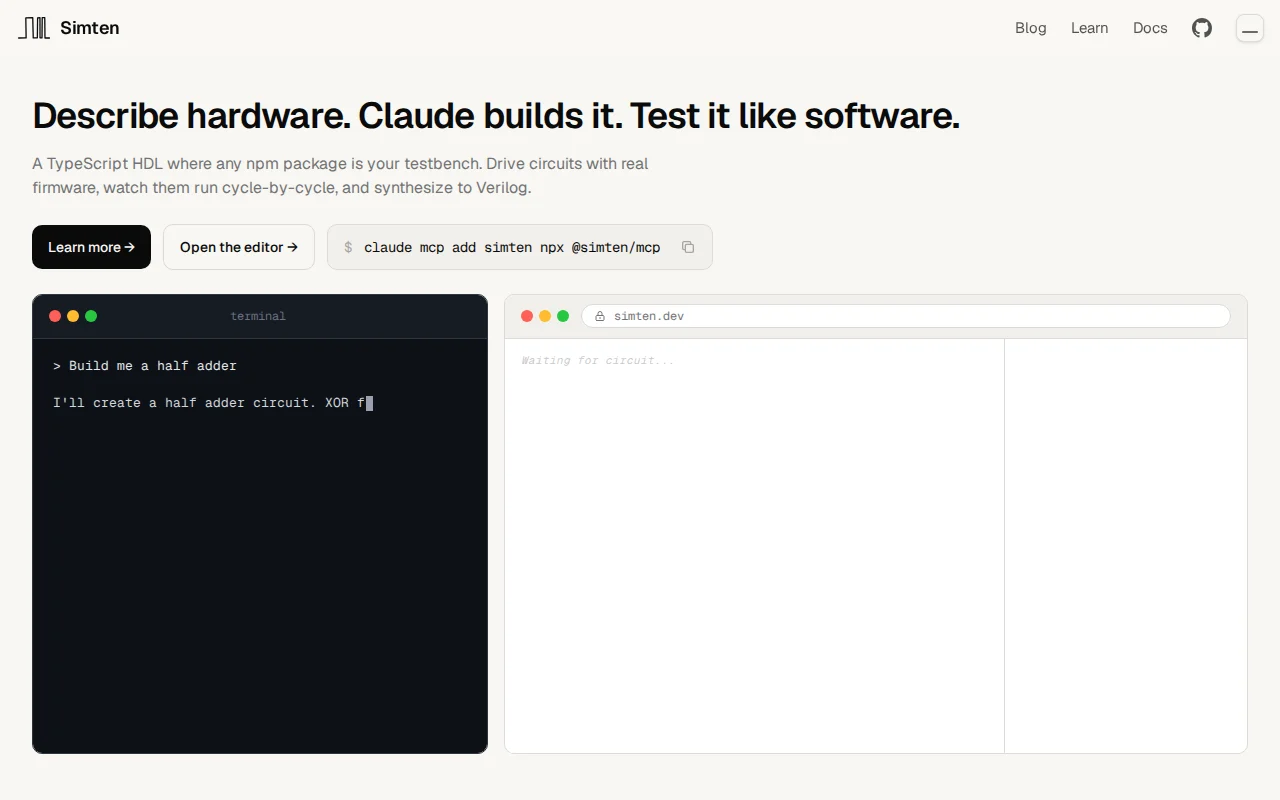
Simten is a hardware description language that's plain TypeScript. A circuit is a typed value you simulate cycle by cycle, in node or the browser, with an interactive view you can drill into and toggle back and forth across cycles. There's nothing to install to see it run, and a circuit drops into a web page as a live component. It still exports Verilog for the existing primitives (very early, flat module) when you want to take a design further. Also since it is TS, you can do cool things like use existing libs from npm and integrate them into the simulation at compile time i.e. load in data, bake it into the ROM and then run it. The figlet example on the landing page hero shows this in action.
There is also an MCP that allows you to build with Claude and push to the browser locally (I know most probably won't want to learn the syntax).
As for what I have done with it so far:
- snake/pong at the gate level (actually harder than it sounds!) - rv32i (risc-v) CPU that is able to run C/C++/Rust compiled with GCC/rustc - run the output verilog (alongside a few board-specific extras) through the OSS FPGA toolchain i.e. Verilog -> Yosys -> nextPNR -> flashed and running on my ULX3S
Interested to hear what you think and if people would actually use it. I was thinking the interactive aspect of it could be useful in CS courses. So letting students see pipeline hazards happening cycle by cycle instead of a static example in a textbook.
- https://simten.dev/circuit — the playground (write/simulate circuits) - https://simten.dev/cpu/rv32i — the RISC-V CPU you can step through - https://github.com/simtenHQ/simten — the repo
LeetCode for RTL engineers with browser-based synthesis and 15+ HDL languages.
Correct, portable m68k core as a reusable library—not just a full-system emulator.
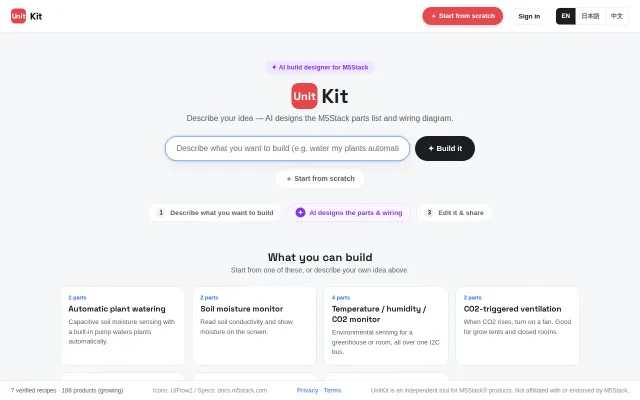
Wiring diagram generation for M5Stack beats manual spec-reading through product docs.
9th-grader's language design project; no working interpreter, mostly aspirational syntax.
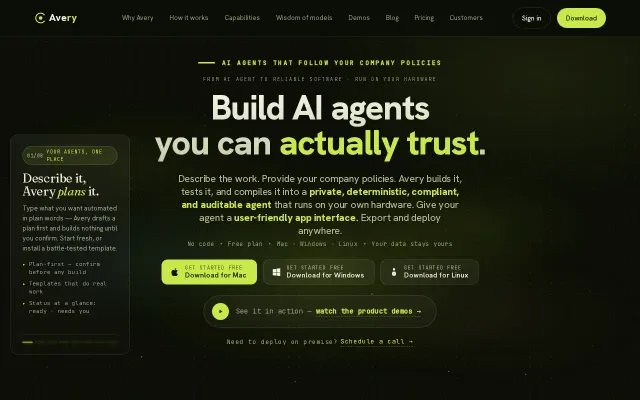
Compiles policies into deterministic agents, but 'trustworthy AI' is a crowded claim without novel proofs.
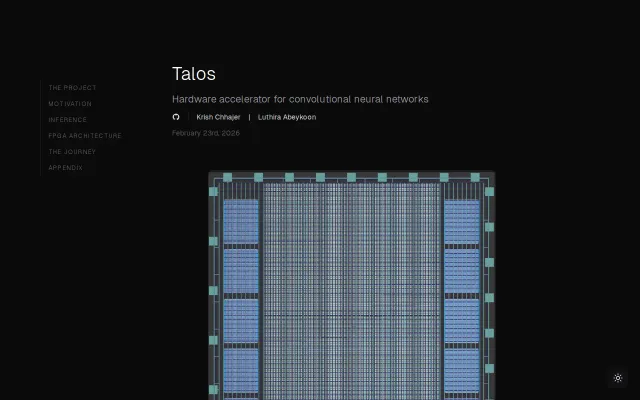
Strips away PyTorch flexibility entirely; full CNN inference as deterministic hardware logic in SystemVerilog.