Finance●Mid
AgentGuard – control layer for AI payments (built in 24h)
Built in 24h on day one of AgentPay SDK — concept over working tool.
Ship ItBold Bet
thstart
214mo ago
Governed execution for machines across payments, Web3, and other critical operations with configurable risk model based on threshold cryptography.
Intent-bound cryptographic proofs for AI agents when existing guardrails lack verifiable authorization.
Backend developers building AI agent systems, security engineers
Oso · OpenPolicyAgent · Ceramic
It allows you to restrict and audit AI agent workflows, blockchain operations, certificate issuance, and any actions that can be expressed as a structured intent.
In simple terms, the proposed interaction looks like this:
1. Machine sends an intent to TKeeper. 2. TKeeper understands the request, executes the policies, and if everything is OK, signs the action (in the case of blockchain operations, this is a transaction signature). 3. The signed intent is sent by the machine to the backend. 4. Backend verifies signature and does its job.
This mechanism makes all "permissions" for actions intent-bound, so we believe it is very effective against LLM06: Excessive Agency, if its primary use case is guardrailing AI.
We also believe that concentrated risks are greatly underestimated, so TKeeper is based on multi-party computation based threshold schemes.
This means that with a quorum setup, it can withstand up to t-1 compromises, allowing risk sharing between or within organizations. For the fastest time to market, you can deploy 1-of-1 setup and then promote it to t-of-n.
Additionally, the following features are built-in: 1. Audit logging & Asset inventory 2. Four-eye control for keys that require human verification. 3. The entire key lifecycle follows the canons: rotation, destruction, and resharing.
Feedback is greatly appreciated :')
Built in 24h on day one of AgentPay SDK — concept over working tool.
Fail-closed policy layer blocks LLM tool calls before execution, no LLM in decision path.
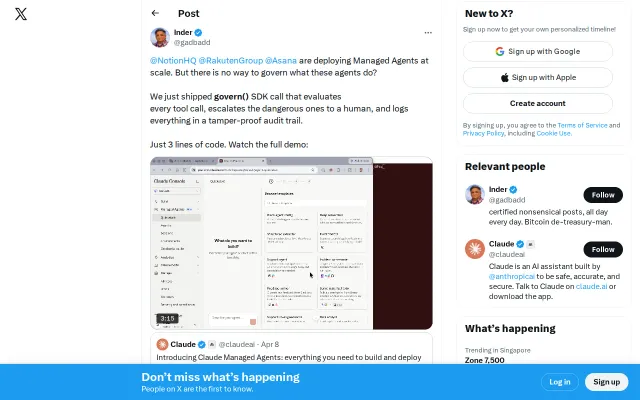
ECDSA-signed audit trails for Anthropic Managed Agents in just 3 lines of code.
Blinded OPRF identities and nuanced verification labels beat C2PA's binary signed/unsigned.
Agent auth via key-signing beats API keys and OAuth for autonomous systems.
Verifiable decision replay for autonomous systems, but execution complexity limits adoption beyond safety-critical domains.