Developer Tools●●●Banger
InferShrink – Cut LLM API costs 10x with automatic model routing
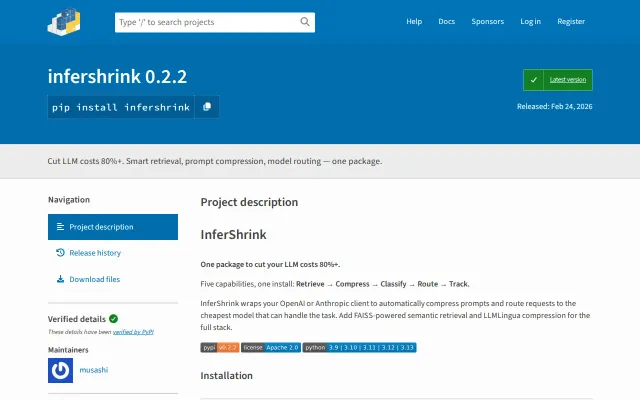
Three-line wrapper cuts LLM costs 80%+ via prompt classification and same-provider routing.
Solve My ProblemShip It
doronp
203mo ago
Route prompts to the cheapest model that handles them. Claude + GPT-4o + Groq. Live cost tracking. Built with pydantic-ai + litellm.
pydantic-ai structured routing decides cheapest model before litellm executes.
Developers building LLM-powered apps who need to optimize inference costs
LiteLLM · LangChain · Portkey
Three-line wrapper cuts LLM costs 80%+ via prompt classification and same-provider routing.
LLM cost routing with LoRA awareness when LiteLLM already handles basic proxying.
Yet another LLM orchestration layer over LiteLLM + Pydantic when DSPy and LangChain dominate.
@@ syntax avoids IDE collisions and chains block outputs in one prompt.
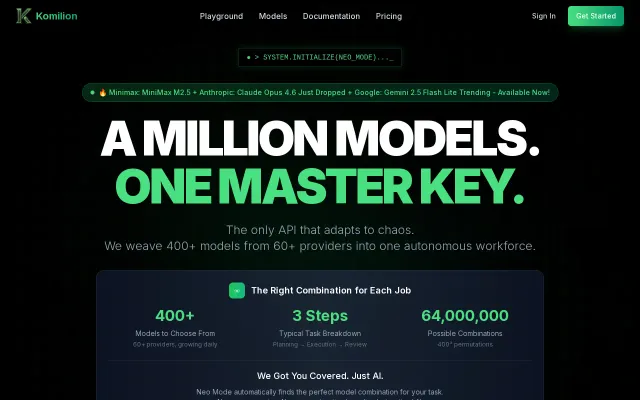
Komilion turns model sprawl into a cost-control layer you drop in by swapping a base_url: requests are classified (regex fast path + tiny LLM) and matched to ~400 models so cheap models handle the easy stuff and premium models only run when needed. The ~60% zero‑call regex fast path and benchmark-driven routing (LMArena) are clever, pragmatic moves; the hard questions left are model-quality drift across providers and how routing decisions map to real-world user satisfaction.
If you're burning through Claude/OpenAI credits, this is a low-friction stopgap: it classifies prompts in ~10ms and routes trivial tasks to cheaper/local models while reserving premium APIs for complex work. The agentic-task detection, reasoning-aware routing, session pinning and context-window fallback are practical touches that avoid mid-thread model bouncing and 429 failures. It isn't reinventing the space (OpenRouter and others exist), but it's focused on real-world cost tradeoffs and drop-in compatibility.