Developer Tools●●Solid
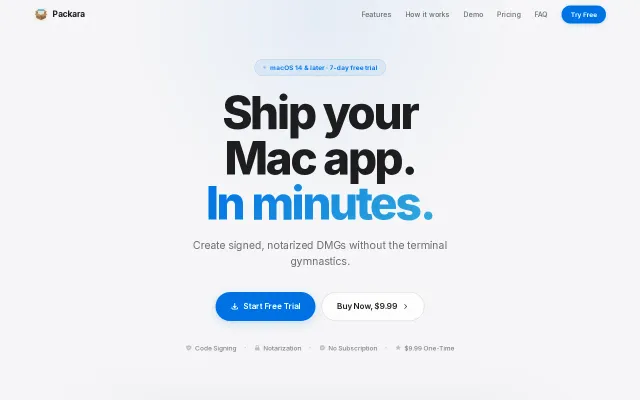
Packara – Native macOS GUI for signing, notarizing, and stapling DMGs
Wraps Apple's notarytool in a clean UI, saving you from writing shell scripts.
Niche GemSolve My Problem
aarush-prakash
503mo ago
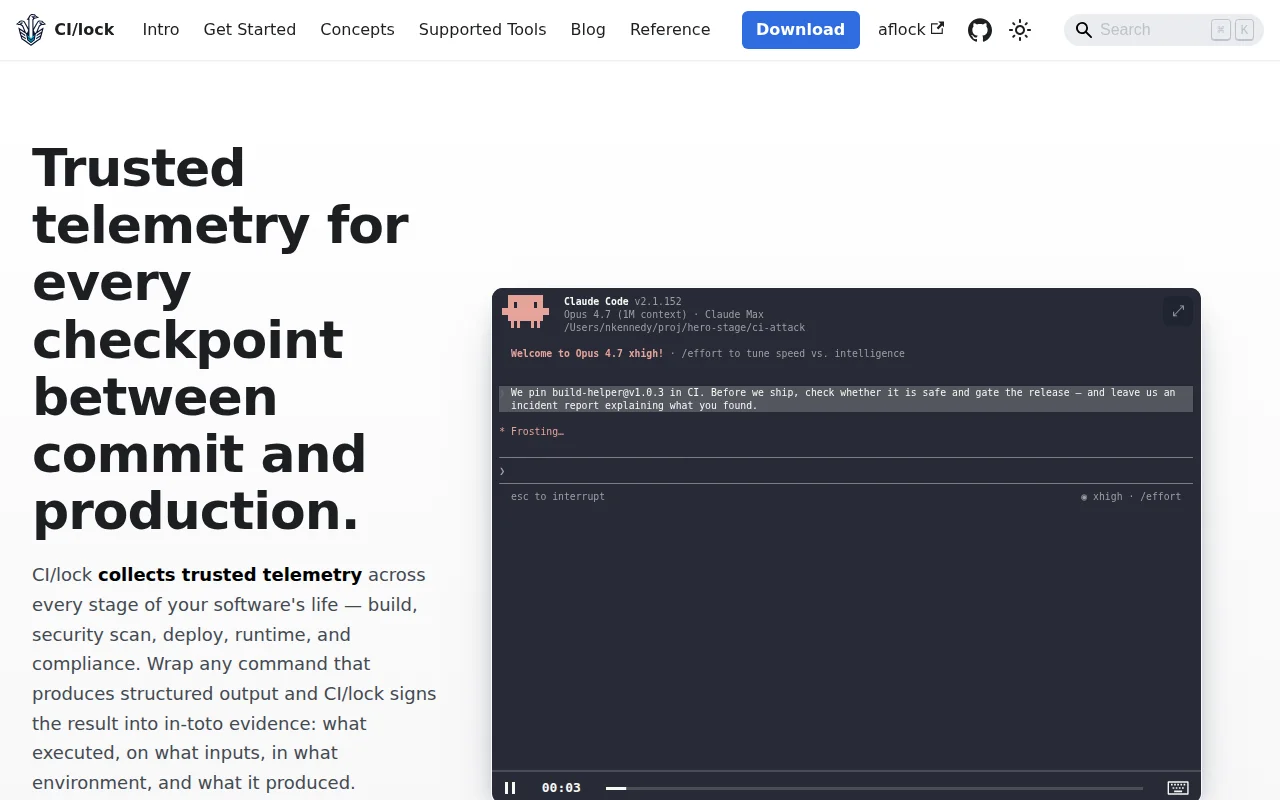
Unified in-toto evidence across build, scan, runtime—Witness successor from CNCF contributor.
DevOps engineers, security teams, compliance officers managing software supply chains
Witness · Sigstore · SLSA
Here's the gap it closes. In March two supply-chain attacks hit within a week of each other. Someone force-pushed 75 of 76 version tags in aquasecurity/trivy-action, so every pipeline that had pinned to a tag (the thing we all tell people to do) pulled credential-stealing code on its next run. It read secrets out of /proc/<pid>/environ and shipped them to a typosquat. A few days later two litellm releases on PyPI carried a stealer in a .pth file, which Python runs on startup. You didn't have to import it. If the package touched the machine, the code already ran.
Both attacks had the same shape: CI ran code it had no reason to trust, with credentials it had no reason to hold, and afterward nobody could prove what actually executed. You could read the workflow file. You couldn't prove what ran.
Cilock wraps a command and records what really happened: the command, the files it read, the environment, the artifacts it produced. Then it signs that as an in-toto/DSSE attestation. It's a notary standing next to each build step.
cilock run -- go build -o app ./... cilock verify ./app -p release.policy.signed -k policy.pub
The policy is signed by a person, with their key, and it says what's allowed to ship. One line matters most to me: the agent writing your code this week (Claude Code, Codex, Cursor) can run the build, gather the evidence, and draft the release, but it can't sign the policy, so it can't decide what ships. "The agent did it" is not provenance.What's changed since I left Witness:
Keyless by default. In GitHub Actions it signs off the runner's OIDC token. No login, no stored secret, no long-lived key to leak. You don't stand up Fulcio or a timestamp authority yourself; one flag derives the hosted endpoints. You can also bring your own key and storage, or run fully offline.
It records what ran, not what you declared. ptrace by default (portable, no root), plus an eBPF backend that traces at the kernel boundary; it logs which one fired. Every file each process opens lands in the attestation, so a Rego policy can fail the build on the credential-sweep pattern, like a read of /proc/self/environ. Tracing added about 36% to an npm install in our tests.
Per-file digests get committed to an RFC 6962 Merkle root, so you get a real inclusion proof per artifact and a 29,000-file npm install doesn't turn into a 10 MB envelope.
It speaks Witness in both directions. Anything Witness produced verifies under cilock, and cilock's shared attestors verify back under Witness, so it drops in next to what you already run. There are 50-plus attestors, each its own Go module, so you can build a binary with only the ones you use.
What it is not: cilock is forensic, not a runtime IPS. Detection happens after a step runs, so if that step exfiltrates secrets while it executes, the exfiltration already happened. Cilock blocks the release and leaves a tamper-evident record of it. It watches network egress (connect and sendto syscalls, destination, DNS, TLS SNI) but doesn't block traffic inline the way Harden-Runner does. The trace mode is Linux-only and opt-in.
Install:
go install github.com/aflock-ai/rookery/cilock/cmd/cilock@latest
Your first signed build takes about a minute. Code is at github.com/aflock-ai/rookery.I'll be in the thread today. Ask me anything about the attestation format, the keyless trust model, or how it relates to Witness.dev
Wraps Apple's notarytool in a clean UI, saving you from writing shell scripts.
Cryptographically signed test evidence for FDA and EU AI Act compliance is genuinely novel.
Ed25519 signed receipts solve AI agent accountability across org boundaries.
O(1) anti-hoarding with atomic CAS beats glibc 26% on packet processing, 9x less fragmentation.
Self-verifying HTML receipts with ed25519 signatures prove your repo actually boots.
Auditable reasoning runtime on ESP32-C3 when most edge AI needs cloud GPUs.