AI/ML●●Solid
An experiment in giving coding agents long-term memory
Persistent memory for coding agents when Cursor and Devin already dominate this space.
Ship ItBold Bet
yacc2
113mo ago
the agent that never starts from zero
Agent memory stored as editable markdown files instead of hidden vector databases.
Developers building with AI agents, local-first productivity users
Cursor · Claude Desktop · OpenInterpreter
Think of it as Obsidian + Hermes in one native app, with extra features.
The key is that it uses the folder as its own wiki to keep track of your work and artifacts, so it stays at the tip of your work without needing you to explain twice.
Some important features:
1. Long-term memory: Orbital stores all memory as .md files locally. It uses a two-tier approach. Tier 1 is a few files injected directly into the system prompt. Among them is an index.md, which is how the agent remembers what the tier 2 files are and when/how to use them. You can open the folder and read everything it knows.
2. Project as sandbox: You set up a "project" in a local folder — same idea as a Claude/ChatGPT project. But the agent can create, update and delete project files when needed (you can set it to ask for your approval first). The agent's shell commands are restricted to a sandbox. Seatbelt on macOS, a separate user account on Windows
3. Sub-agent support: It can directly dispatch Claude Code (official Agent SDK) and Codex (App Server protocol) as sub-agents, using your existing subscription. Parallel agent fan-out is also supported.
Other basic features include cron jobs, task queue, budget control, etc.
Solo builder. Built in 1 month. But it took me 3 months to dogfood and stabilize. Now I can proudly say I use it every day and it has replaced my original Claude workflow.
One example I can share is orbital-marketing. I set up this project with all my architecture and product design files, plus a cron job that monitors competitor features daily, and I use the artifacts to adjust my product roadmap. It's also my central hub for content creation like video scripts as the agent needs to understand the nuances between Orbital and other products. Another project is orbital-feature-log, which helps me write specs against the repo, dispatch Claude Code to investigate the implementation plan and Codex to implement. Orbital does the final check.
It comes with a UI. You can download it and set it up within 3 minutes.
release link: mac:https://github.com/zqiren/Orbital/releases/download/v0.7.1/O... windows:https://github.com/zqiren/Orbital/releases/download/v0.7.1/O...
Persistent memory for coding agents when Cursor and Devin already dominate this space.
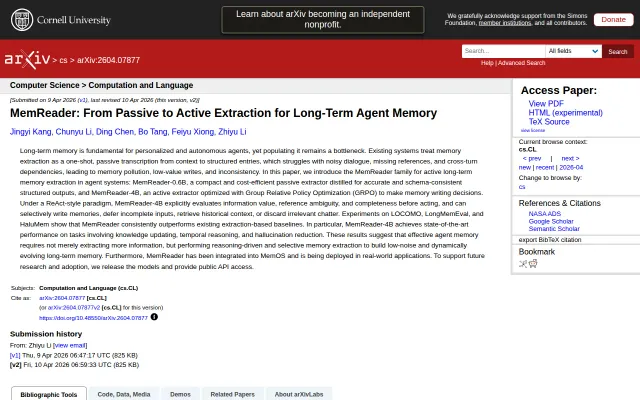
Active memory extraction with GRPO beats passive transcription on LOCOMO benchmarks.
Database-inspired two-tier memory beats context-window stacking for AI agent recall.
Folder-based agent memory means zero infrastructure, just git-tracked plain text.
Hierarchical scopes let teams share code style rules across agents.
Single-file SQLite memory for LLMs simplifies complex vector DBs for local workflows.