Developer Tools●Mid

Production-Ready MERN Job Board Template
Competent MERN starter kit, but niche job board templates are a saturated category.
Ship It
hlymrk
102mo ago
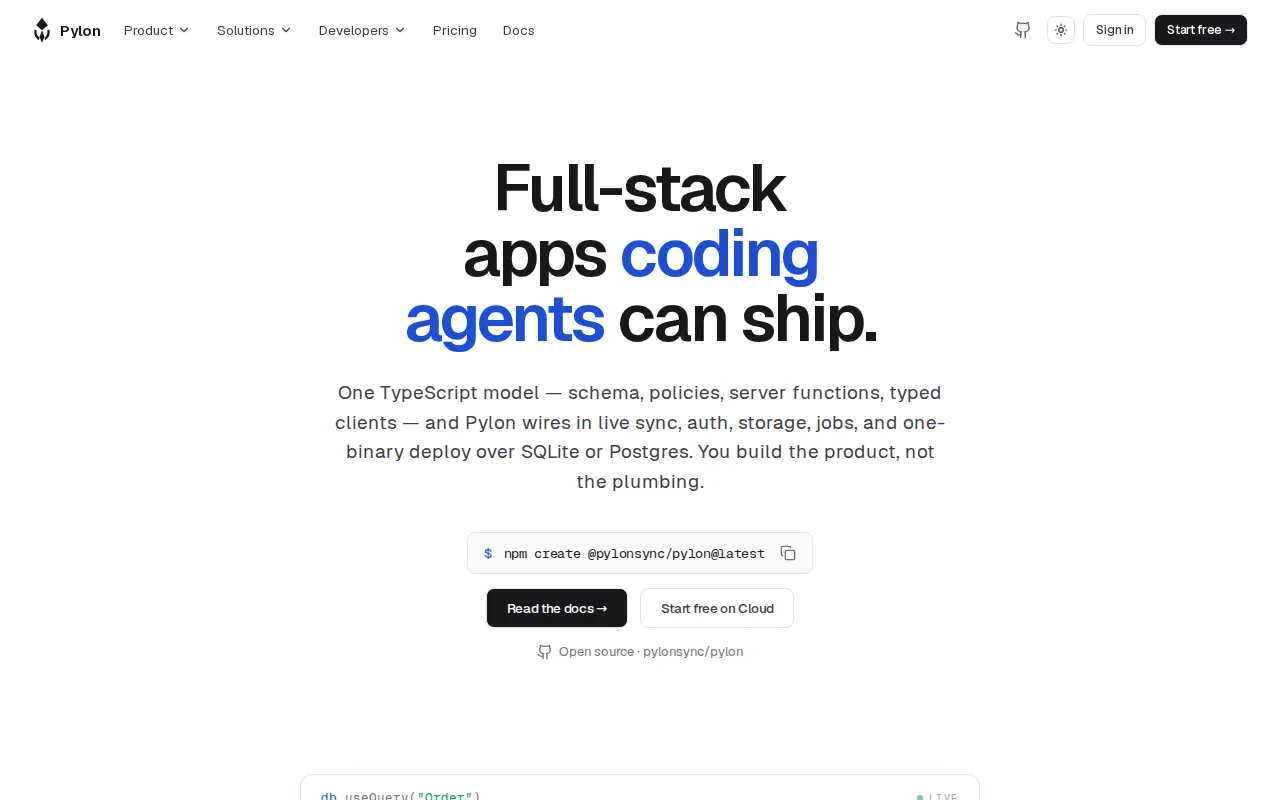
One TypeScript model wires in live sync, auth, and jobs without separate backend services.
Full-stack developers building production React apps
Convex · Supabase · Remix
For hobby projects, I usually reach for a pure Next.js app. It is fast, familiar, and easy to deploy to Vercel. For production apps, I usually split the frontend from a standalone backend, then deploy the backend on AWS. That setup works, but it feels heavier than it needs to be for a lot of products.
Pylon is my attempt to simplify and make it easier for agents to ship full stack apps.
The framework is inspired by what Rails gave people back in the day: a strong default path, an app structure, and fewer decisions before you can ship. Pylon applies that to modern React apps, realtime sync, TypeScript server functions, auth, background & scheduled jobs, and deployment.
Pylon is a full-stack realtime framework. It has server-rendered React, TypeScript functions, entities and policies, realtime sync, built-in auth, and background/scheduled jobs. It starts with SQLite by default, but can run on Postgres when you want a more standard production database. The auth system is heavily inspired by better-auth. The runtime is a Rust server that runs your TypeScript functions and server-rendered React through Bun.
The agent angle is a big part of it. I wanted something a coding agent could create with zero config, understand quickly, keep secure by default, and deploy without stitching together a bunch of third-party services. It should work for throwaway apps, but also for production apps where you eventually care about performance, ownership, and self-hosting.
Pylon Cloud is the hosted version. Its DX is heavily inspired by Vercel: deploy from git or the CLI, get a URL immediately, attach custom domains, and avoid thinking about servers at the start. Under the hood each app gets a real server that can scale to zero, with TLS and caching in front.
I would like feedback from people who have built with Next.js, Vercel, Convex, Supabase, Firebase, better-auth, or Rails. The framework is intentionally opinionated, so I’m curious where it feels useful and where it feels too constrained.
Website: https://www.pylonsync.com
Repo: https://github.com/pylonsync/pylon
Docs: https://docs.pylonsync.com/introduction
LLMS: https://docs.pylonsync.com/llms.txt
Skill: npx skills add pylonsync/pylon
Examples: https://github.com/pylonsync/pylon/tree/main/examples
Competent MERN starter kit, but niche job board templates are a saturated category.
End-to-end TypeScript typing for agents when Vercel AI SDK already handles this well.
Production-focused agent lib, but LangChain and CrewAI already own this space.
Annotated Markdown as source of truth, code as compiled output from AI agent.
GitHub company tech detection is clever, but job boards are saturated.
Python-to-JS compilation for full-stack apps, but Reflex and Flet already exist.