Developer Tools●●●Banger
GrandPerspective-style treemaps for the web and disk usage visualizer
GrandPerspective-style treemaps running in the browser with millions of nodes.
Eye CandyWizardryNiche Gem
thad_imbue
502mo ago
A text-mode disk usage visualization utility
Renders proportional treemaps in pure text mode for remote servers without GUIs.
DevOps engineers, system administrators, remote server users
ncdu · WinDirStat · gdu
On containers or remote servers, the options are limited to purely text based utilities (e.g. du) or list-centric TUIs (e.g. ncdu) which are usually limited to viewing one directory at a time.
I created leaves to fill that gap.
Inspired by classic utilities like WinDirStat and KDirStat, it uses a 2-dimensional treemap^1 visualization to show the entire directory hierarchy with proportionally sized rectangles.
It's performant enough to handle millions of files, thanks to Rust and multi-threading. However, block characters aren't as suited as pixels for resolving a large number of items. Leaves can show file-type summaries per directory or partition the top-level directories by extension, allowing you to see not only where space is being used, but also how.
For instance, I can see the largest chunk of my home directory is taken up by uv caches for python and old Linux ISOs that I could easily re-download if needed. Or in a particular container, +600MB is used by standard Rust documentation and tutorials, and that it is the only location with HTML/JS files, when only the libraries and build tools are needed (note to self: remember to use the minimal profile next time).
^1: https://github.com/shundhammer/qdirstat/blob/master/doc/Tree...
GrandPerspective-style treemaps running in the browser with millions of nodes.
Another treemap disk analyzer when DaisyDisk already dominates this space.
Yet another disk usage TUI when ncdu and gdu already dominate this space.
ncdu replacement with 2x speed and trash support, but ncdu already solved the problem well.
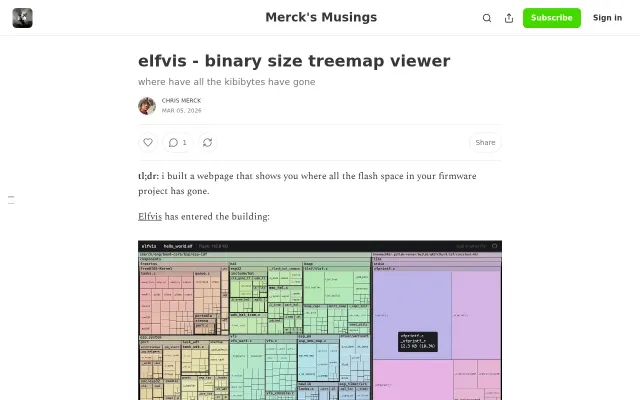
WASM treemap visualizer beats Bloaty for instant firmware bloat diagnosis.
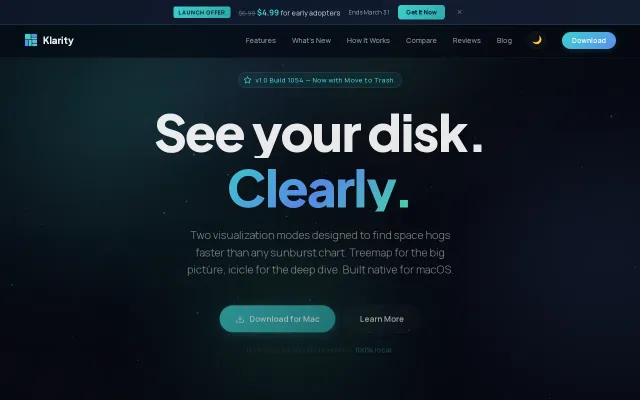
Treemap plus icicle views and native SwiftUI builds give Klarity snappy local scans and a modern UI, with handy touches like Move to Trash and a menu-bar RAM monitor. It’s an attractive, lower-cost alternative to DaisyDisk with privacy (no telemetry) baked in — but it’s more refinement than innovation in an already crowded niche.