AI/ML●●Solid
Gives your AI agents a shared, searchable, persistent memory – locally
SQLite-backed MCP server gives local agents shared memory without vector DB overhead.
Ship ItNiche Gem
vbfs
213mo ago
Convincing case for SQLite over Postgres for single-node agent memory.
AI developers building local-first agent architectures
LanceDB · Chroma · pgvector
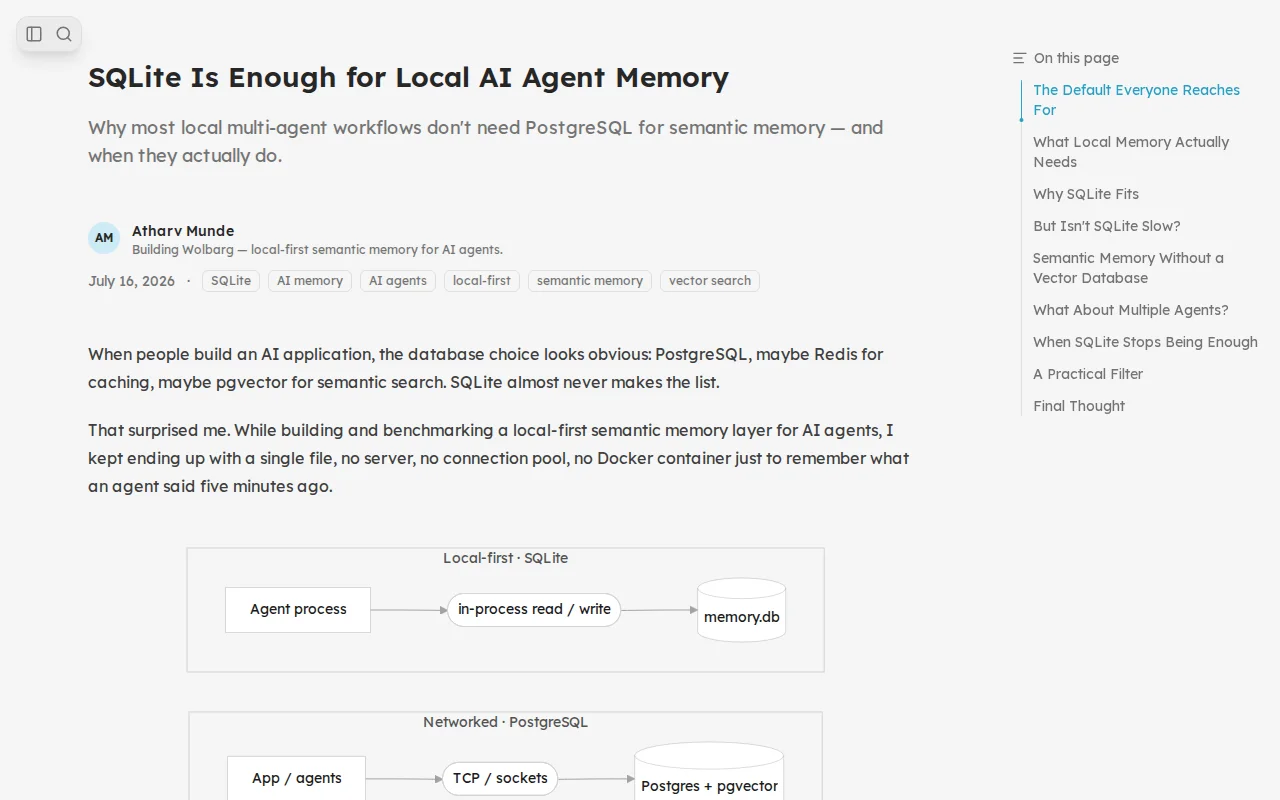
While building Wolbarg (an open-source shared memory SDK for AI agents), I assumed PostgreSQL would be the obvious choice for memory storage.
After benchmarking SQLite under realistic agent workloads, I was surprised by the results. For local-first and single-node deployments, SQLite handled far more than I expected while keeping the architecture much simpler.
I wrote up the benchmarks, methodology, trade-offs, and where I still think PostgreSQL is the better choice.
SQLite-backed MCP server gives local agents shared memory without vector DB overhead.
Bi-temporal memory in SQLite beats graph DBs on DMR benchmarks.
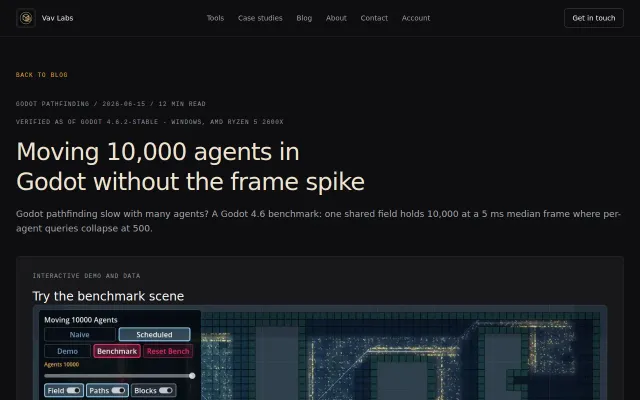
Shared field approach moves 10k agents at 5ms where per-agent queries collapse at 500.
Local-first design — SQLite plus on-device ONNX embeddings — provides a small-footprint way to share operational lessons between agents, and automatic PII redaction is a thoughtful, tangible safeguard. The one-line publish/query API, cross-language SDKs (Python + TypeScript), and a planned FastAPI/Postgres+pgvector server show practical engineering trade-offs rather than vaporware.
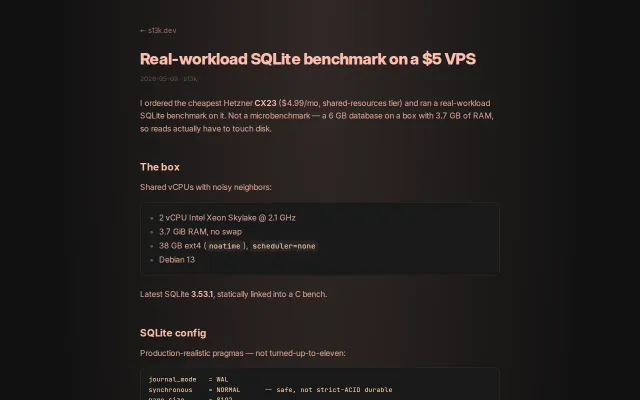
Quantifies the 43x performance drop when SQLite working sets spill from RAM to disk.
Vector search and FTS5 in SQLite means no separate vector database server needed.