Gaming○Pass

Send Secret Message in a Maze
Charming puzzle game, but lacking depth, replayability, or clear use case beyond a one-off novelty.
Cozy
bilkoo
104mo ago
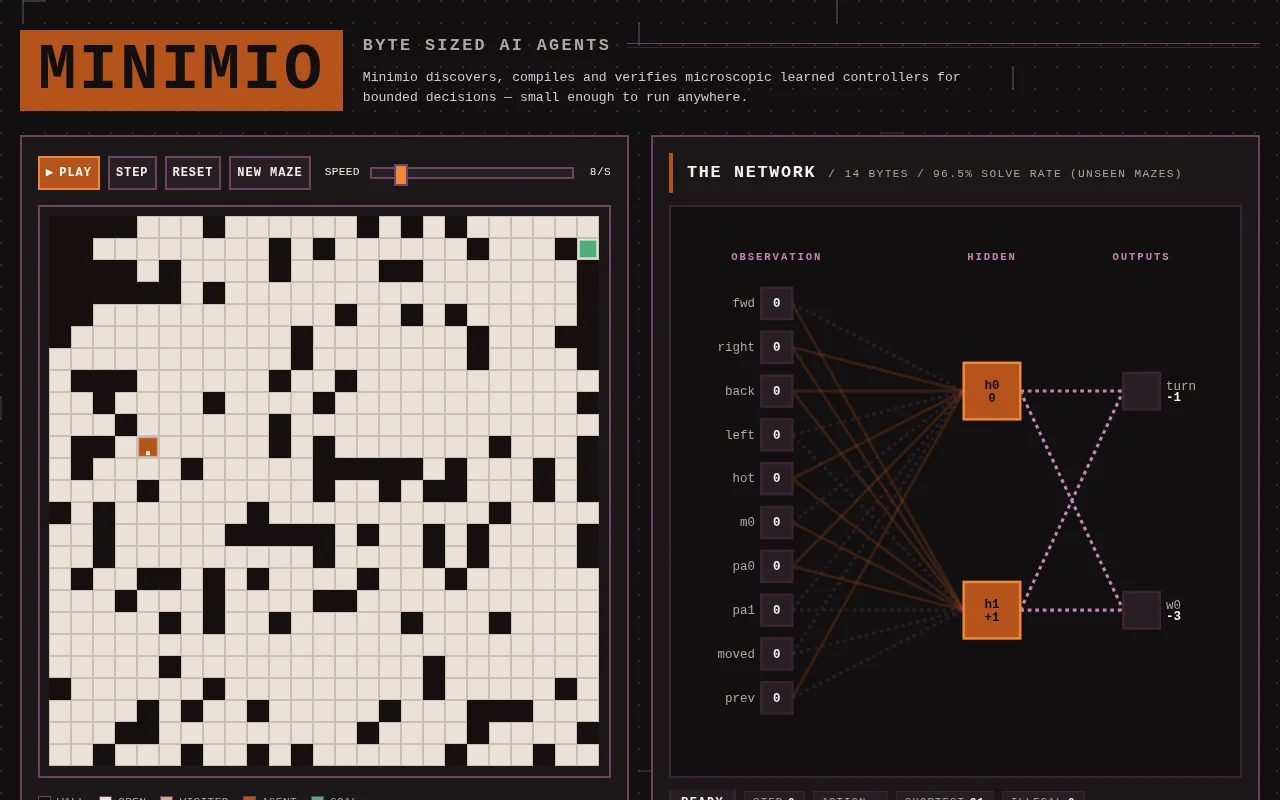
14-byte neural nets solving mazes with zero map data is genuinely impressive constraint engineering.
ML researchers, embedded systems engineers, and AI hobbyists
MarI/O · NEAT · TinyML
I built this project over the last few weeks as a palette cleanser from a failed game launch.
I wanted to learn a bit about AI/Neural-Networks and naively thought I could build a tiny maze-solving AI in a weekend with a 100% solve rate.
Well - I couldn't, but I got pretty close. 14 Bytes total model size, and a 96.5% solve rate on unseen mazes. Trained across 46 phases experimenting with different ideas to improve the model (better performance, smaller size).
Its quite fun to watch the model attempt to solve the maze, when they fail its usually due to getting stuck in a loop. The models have no access to coordinates, map-data, or external memory scratches - they must navigate using only immediate local neighbourhood observations.
There is a model dropdown and you can see how the model has progressed over each phase, constantly getting smaller and increasing its solve rate. Total trained models number in the thousands - I just expose the winning models from each phase.
Overall a fun experiment, with much implementation help from AI agents to scaffold and implement the code (I'm a lazy software dev).
Charming puzzle game, but lacking depth, replayability, or clear use case beyond a one-off novelty.
Five AI agents attempt Brook Farm utopia and inevitably fail in simulation.
Satisfying WebGL physics demo that runs entirely client-side with no dependencies.
rDCIM flow fields with LLM interpretation — novel brain connectivity visualization for researchers.
Unverified LLM attempt at open math problem without expert validation.