AI/ML●●●●Gem
Experiments Mapping the "Primitive Layer" in Language Models
Semantic primitives show up in activation patterns across Qwen, Gemma, LLaMA, SmolLM2.
WizardryBig BrainZero to One
dchisholm125
202mo ago
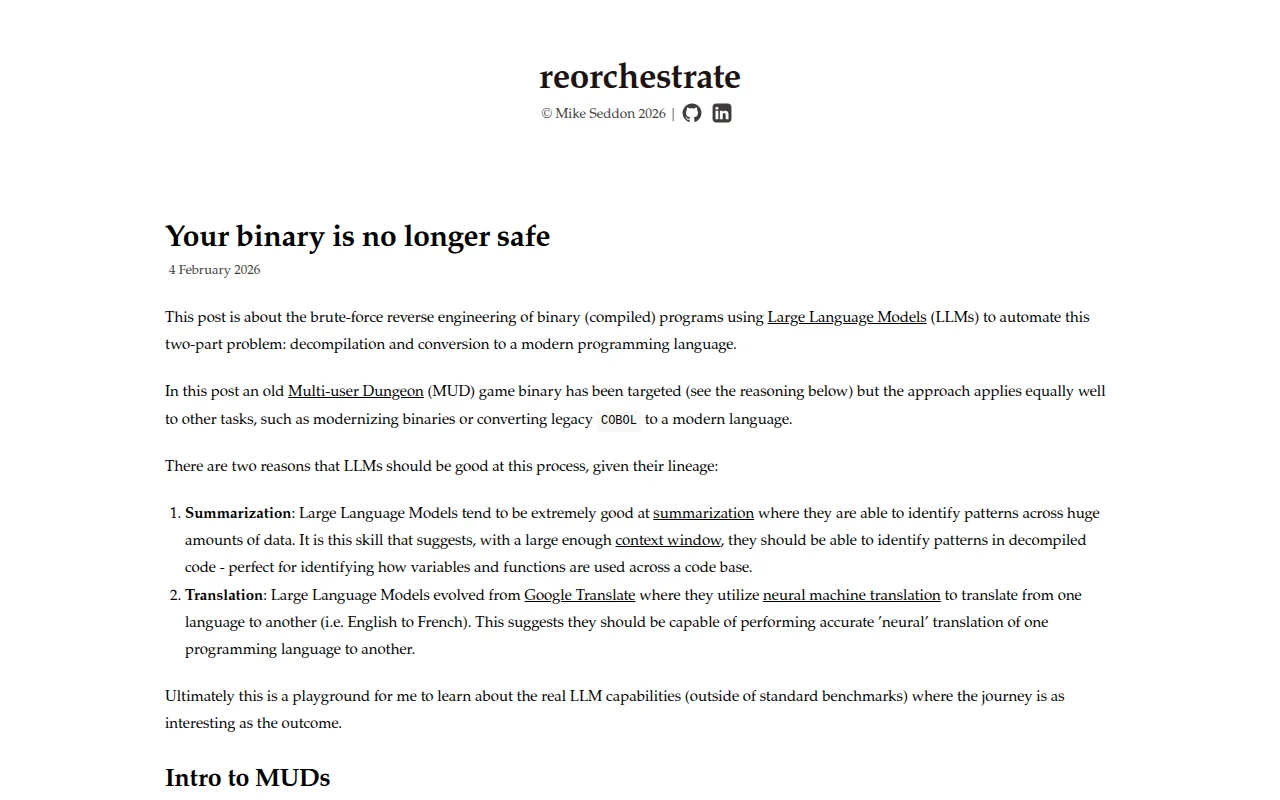
Uses differential-property testing as an automated feedback loop to validate LLM-driven rewrites — that's the clever bit that turns flaky translations into repeatable refinement. The author targets a closed-source MUD DLL to avoid model memorization and walks through why raw assembly prompts failed and how decompiled C+tests + LLM translation to Rust succeeds. It's a thoughtful, slightly alarming demo with concrete techniques you can try yourself, not just vaporware.
Reverse engineers, security researchers, systems/legacy maintainers, developers interested in automated code translation
The most interesting part for most will likely be the demonstration on how to use differential-property testing to automate the LLM feedback loop for the rewrite (translation) phase (in this case to rewrite to Rust).
This that I believe would solve the 'rewrite issues' discussed recently here: https://news.ycombinator.com/item?id=46954696
Semantic primitives show up in activation patterns across Qwen, Gemma, LLaMA, SmolLM2.
Tutorial code for SFT pipeline, but dozens of identical examples exist on GitHub.
Defense-in-depth AI agent firewall: proxy + eBPF kernel + three-tier injection detection.
Potatoverse promises app+DB hosting, but repo README is sparse and demo link barely loads.
YouTube video with vague claims — no actual product or explainable technique shown.
Nine-language code generation with LSP support when Protobuf dominates.