Education○Pass
![Learn language with word-by-word translation maps [video]](/screenshots/48842818_thumb.webp)
Learn language with word-by-word translation maps [video]
YouTube demo with no working product or code to evaluate.
julienreszka
2011d ago
Graph-Oriented Generation (GOG)
Semantic primitives show up in activation patterns across Qwen, Gemma, LLaMA, SmolLM2.
AI researchers, interpretability researchers, ML engineers
The finding that surprised me: Language model behavior follows a reproducible taxonomy (Synthesis, Collapse, Overflow, Metacognition, Linguistic Drift). It's not random noise — it's classifiable.
The finding that matters for interpretability: Structure is a more reliable control variable than content. Telling a model how to structure reasoning produces consistent outputs. Telling it what to reason about doesn't.
The finding that might matter most: Wierzbicka's semantic primitives (WANT, KNOW, FEEL, TIME, etc.) appear as measurable activation patterns in small language models across four different architectures — Qwen, Gemma, LLaMA, and SmolLM2.
18 experiments. 4 architectures. Cross-validated. Real data.
Full paper, experiment code, and primitive vocabulary JSON: https://github.com/dchisholm125/graph-oriented-generation
The primitive layer is waiting to be mapped.
YouTube demo with no working product or code to evaluate.
Tutorial code for SFT pipeline, but dozens of identical examples exist on GitHub.
Another MLOps platform competing with MLflow and Weights & Biases.
New security DSL with built-in recon primitives, but Python already does this.
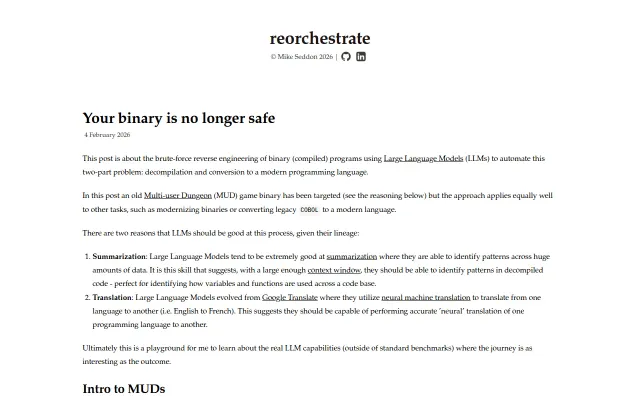
Uses differential-property testing as an automated feedback loop to validate LLM-driven rewrites — that's the clever bit that turns flaky translations into repeatable refinement. The author targets a closed-source MUD DLL to avoid model memorization and walks through why raw assembly prompts failed and how decompiled C+tests + LLM translation to Rust succeeds. It's a thoughtful, slightly alarming demo with concrete techniques you can try yourself, not just vaporware.
Video demo of a personal workflow, not a tool others can actually use.

![Practicing foreign language generating conversation on topic [video]](/screenshots/48472833_thumb.webp)