Productivity●Mid
Free Notion alternative because I think Notion is overpriced
Another Notion clone where privacy and Europe hosting are the only differentiators.
Slick
gabidor
2221d ago
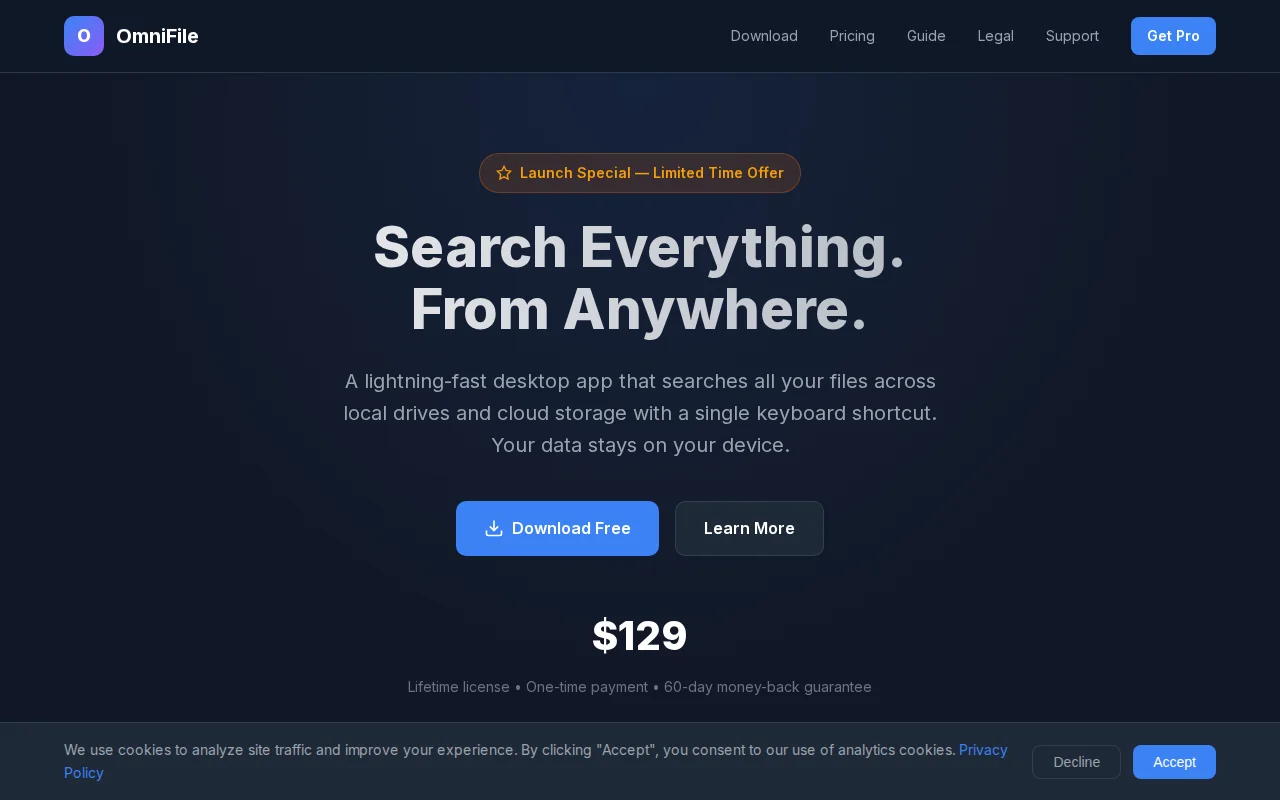
Hit Ctrl+Space and fuzzy-search local drives and cloud sources with indexes that stay on your machine — instant results without uploading file contents. The stack (Tauri + React/TypeScript front-end and a Rust indexing backend) signals genuine attention to native performance and privacy, and integrations with Google Drive, Notion, Slack and SharePoint are the practical draw. It's useful and thoughtfully focused, but the space is crowded so long-term value depends on reliability of indexing, more deep connectors, and how compelling the $129 lifetime license feels to users.
Knowledge workers: developers, designers, writers, and business professionals who keep files across local drives and cloud services
I'm the developer of OmniFile. I built this tool because I was frustrated with having my data scattered across too many platforms and struggling to find what I needed quickly.
OmniFile is a desktop app that lets you search through your local files and cloud services in one unified interface.
Key Features:
Integrations: Currently supports Google Drive, Dropbox, Box, SharePoint, Slack, and Notion.
Tech Stack: Built with Tauri, React, and TypeScript for the frontend, with a Rust backend for performance and secure file handling.
Privacy: It indexes your content locally, so your data stays on your machine.
It’s still in the early stages, so I’d love to get your feedback on the UX and any other integrations you’d like to see.
Another Notion clone where privacy and Europe hosting are the only differentiators.
Polished Notion-to-site converter, but Super and Feather already dominate this market.
Unified model subscription is clever, but "super intelligence" marketing feels like vaporware in crowded space.
Unified credit wallet across ten privacy services solves subscription fatigue, but trust is unproven.
OAuth plumbing layer for agents, but Anthropic's Resources and LangChain already ship this.
HTTP-equivalent standard for air quality data, federated networks, no licensing or hardware lock-in.