Hardware●●Solid
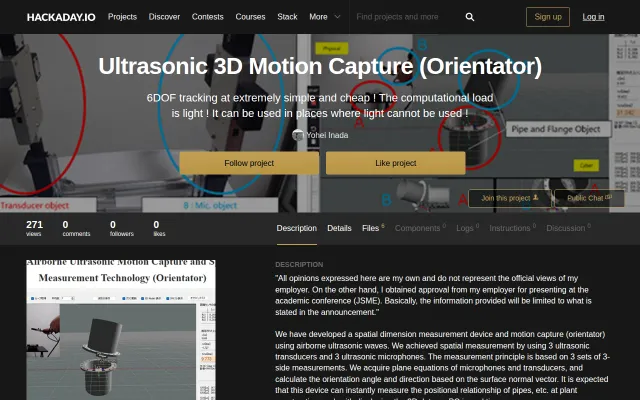
Ultrasonic 3D motion capture (Orientator)
Ultrasonic 6DOF tracking works where optical systems fail in dark environments.
Niche GemBig Brain
optimized75
2022d ago
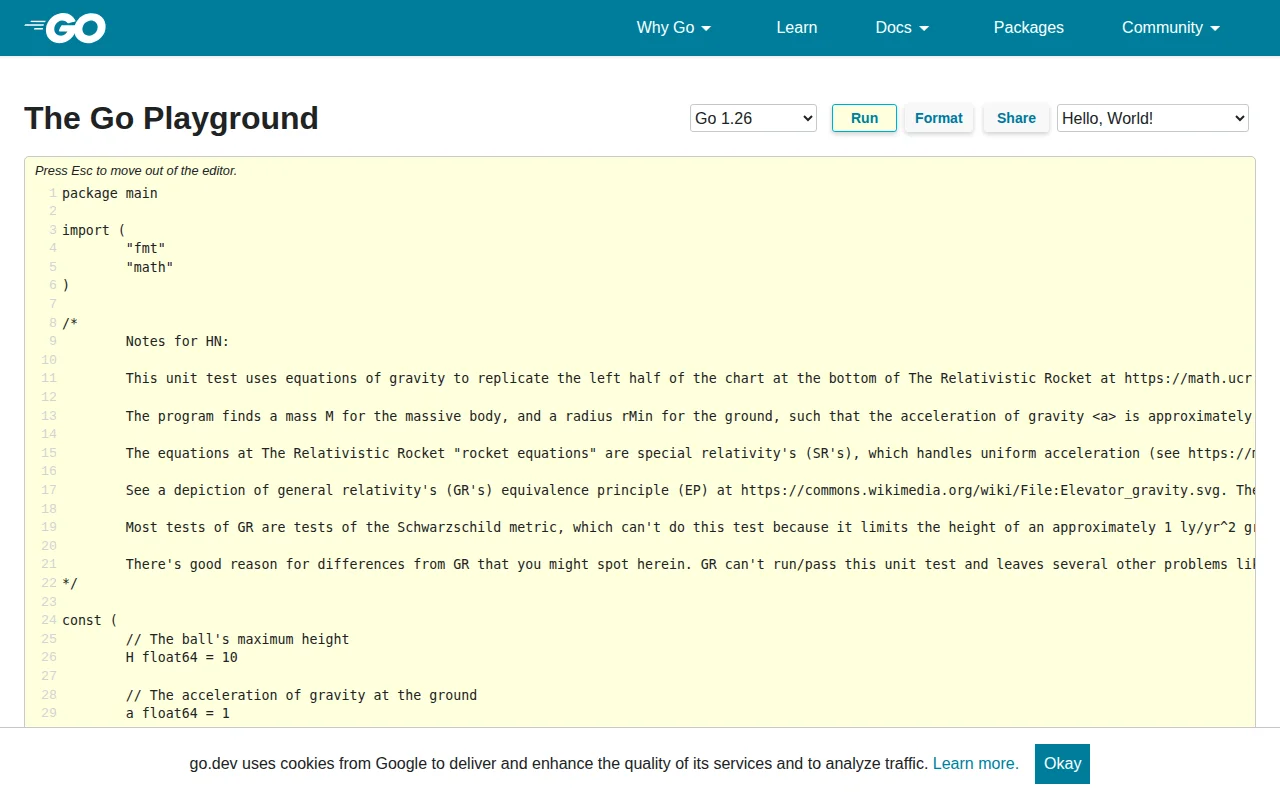
Physics claim requires peer review; Go Playground snippet isn't a publishable project.
Physics enthusiasts, relativity researchers, Go programmers interested in numerical methods
What makes the code significant is that it's the first time that results from equations of gravity (using values for G, M, and r) match results from special relativity (SR) for any inputs for such test, insofar as finite precision allows. This makes the EP fully bidirectional. Click the Run button to see matching results.
Most tests of general relativity (GR) have been tests of the Schwarzschild metric, which limits the height of an approximately uniform gravitational field. It predicts that they can be only so tall in nature. For instance, you might be able to create a 1.0 g field with a height of 1 AU, but not 1 light year. This height is unlimited in SR, which handles uniform gravity tests. Thus the metric can't do a comparison test to SR using the default inputs in the code.
To fix this issue a logical error in the derivation of the metric was corrected, to derive a new metric. Three other issues had to be addressed, so it was like a bug with four causes. The new metric is fully experimentally confirmed (e.g. it predicts 42.98 arcseconds per century for Mercury's Schwarzschild precession) and solves several major problems in physics, like the black hole information paradox.
I have a write-up that explains everything and with more code; here it's just one unit test that other techies might find interesting. Though my findings are considered crackpot theory and so are throwaway, I'm happy with this code in particular. To me the proof is always in the pudding, with experimental confirmation, logical consistency, and passing of unit tests. I learned that the universe is more interesting than we think, with fewer assumptions needed to explain observations.
Ultrasonic 6DOF tracking works where optical systems fail in dark environments.
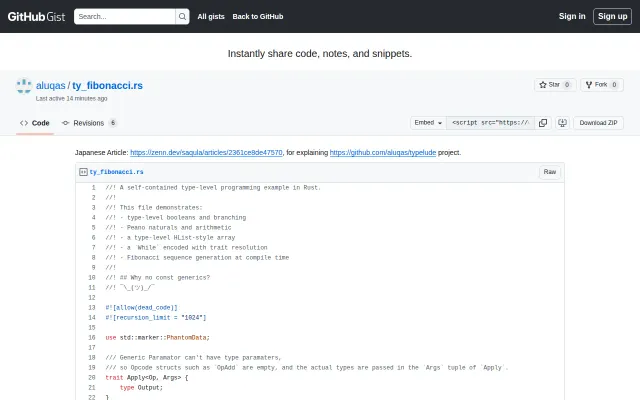
Computes Fibonacci sequences at compile time using only trait resolution and type algebra.
LLM-powered spreadsheet with no formula parser—pure prediction satisfies the contract.
Guided tour builds orbital intuition step by step with real physics.
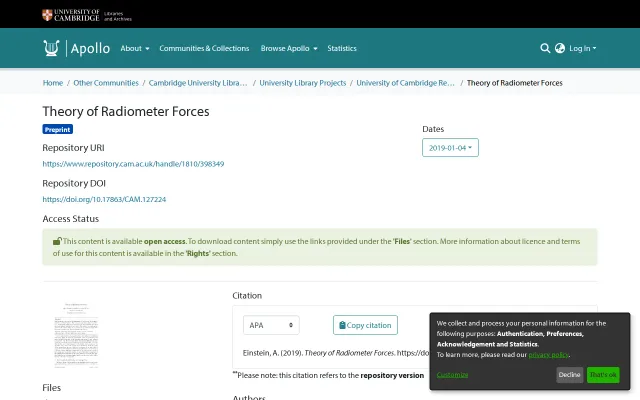
This isn't a startup — it's archival work: a first-time English translation of an obscure Einstein paper with corrections folded into the text and an institutional DOI, which makes it immediately citable. The landing page is functional and trustworthy (Cambridge Apollo hosting), but there's an odd mismatch on rights metadata — the author claims public domain timing while the record shows 'All Rights Reserved' — which deserves a quick fix for clarity.
TDD methodology for AI agents when prompting guides already exist.