AI/ML●Mid
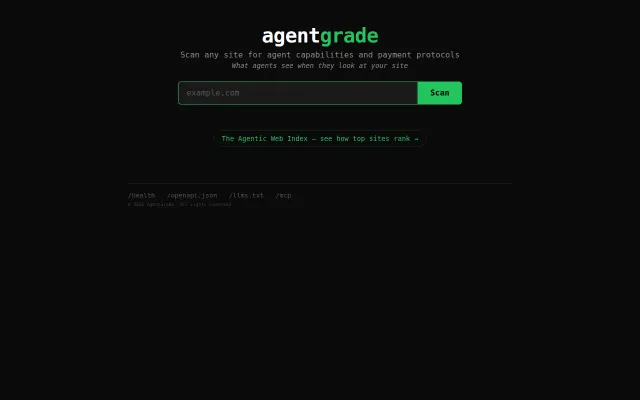
AgentGrade – agent-readiness guide for your site
Timely concept checking for /llms.txt, but it's just four HTTP GET requests.
Bold Bet
usiegj00
711mo ago
Personal portfolio of Vassiliy Lakhonin — Program/Portfolio/PMO leader and AI-policy-tooling builder. Also a reference implementation of an AI-readable professional profile (human pages + JSON endpoints + agent discovery + MCP).
Evidence-mapped CV beats PDF for AI recruiter parsing, but applies only to ATS that read these formats.
Job seekers, recruiters using AI-assisted hiring, professionals building AI-indexable portfolios
JSON Resume format · Open Badges · Structured data (schema.org)
I'm a Not a developer. I built this over a few weeks with Codex+Claude Code.
What I ended up with: https://vassiliylakhonin.github.io/
The interesting design decisions:
Instead of just a PDF, I have six machine-readable JSON files: - resume.json — standard JSON Resume format - evidence.json — maps each claimed metric to its source and verification method. The theory: AI candidate evaluation will increasingly distinguish evidenced claims from unverified ones. - availability.json, capabilities.json, engage.json, verification.json — availability signals, capability profile, intake schema, identity cross-references
llms.txt points crawlers to the pages that matter. robots.txt explicitly allows GPTBot and OAI-SearchBot. JSON-LD (schema.org ProfilePage/Person) on the homepage.
The most experimental piece: a live MCP server on Railway. In principle, an AI recruiting agent could call it as a tool and get structured answers about my background without scraping HTML. I haven't seen anyone else do this for a personal CV, which either means it's ahead of the curve or completely pointless.
The honest version: I have no idea if any of this actually works. I don't know whether recruiter tooling parses llms.txt or JSON-LD from personal sites, or whether everything still flows through LinkedIn scraping and PDF vision models. I built it because structured reporting systems are literally my job, and this felt like the right way to represent that.
Repo: https://github.com/vassiliylakhonin/vassiliylakhonin.github....
Curious: is anyone building sourcing or screening agents that consume structured data from candidate-owned sites? Or does all candidate data still enter the pipeline through LinkedIn and uploaded PDFs?
Timely concept checking for /llms.txt, but it's just four HTTP GET requests.
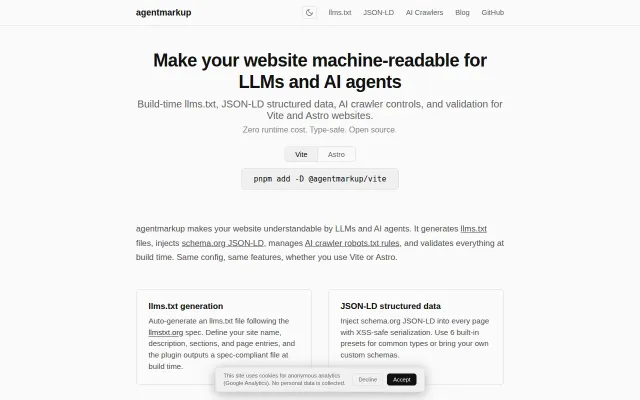
Build-time llms.txt generation before the spec becomes mandatory everywhere.
This is someone treating a CV as structured data rather than a PDF: resume.json, evidence.json, availability.json, agent-card.json and a curated llms.txt are all exposed plus schema.org JSON-LD. Nice touches include GitHub Actions that validate links and push an IndexNow update on every commit — practical engineering to get content noticed by crawlers and agents. It’s a focused, well-implemented experiment, but its usefulness depends on broader adoption or tooling that consumes these bespoke conventions.
This is a practical playbook: the repo bundles resume.json, evidence.json, availability.json, an agent‑card and an llms.txt plus CI checks and IndexNow pushes so your CV is both human- and agent-discoverable. Clever bits: automated sitemap/index pushes, link-checking Actions, and explicit A2A‑style metadata (agent‑card.json) — that’s not something you see on most personal sites. What’s missing for wider credibility are outcome metrics and external verification (recruiter-facing analytics, attestations, or an A/B test showing improved contacts), and a clearer signal-to-noise story for what recruiters should actually consume first.
Zero LLM cost at query time when most MCP doc servers burn tokens on every search.
Schema-valid evidence packs for AI agents when generic evals miss domain nuance.