Back to browse
Tensor Spy: inspect NumPy and PyTorch tensors in the browser, no upload

Tensor Spy: inspect NumPy and PyTorch tensors in the browser, no upload

by jacobn·Mar 2, 2026·22 points·1 comment

AI Analysis

●●SolidSolve My ProblemEye Candy

Local tensor visualization beats Jupyter notebooks for quick diffusion latent inspection.

Strengths
  • Local processing (no upload) + drag-drop file loading removes friction from typical Jupyter inspect workflow—genuine UX win for debugging.
  • Hover-based stats (min/max, mean±std, NaN/Inf counts) and high-contrast rendering surfaces anomalies fast, directly useful for pipeline validation.
  • Dimension slicing/tiling/reshape controls without materializing full tensors is clever—memory-efficient and addresses real large-tensor pain.
Weaknesses
  • Narrow audience: mostly useful for vision models (diffusion latents, features). Transformer token inspection is mentioned but less fleshed out.
  • No persistent project support, export/comparison workflows, or integration with notebooks. One-off inspection tool, not a debugging suite.
Target Audience

Machine learning engineers, data scientists debugging deep learning pipelines and tensor shapes

Similar To

Jupyter Notebook · TensorBoard · Netron

Post Description

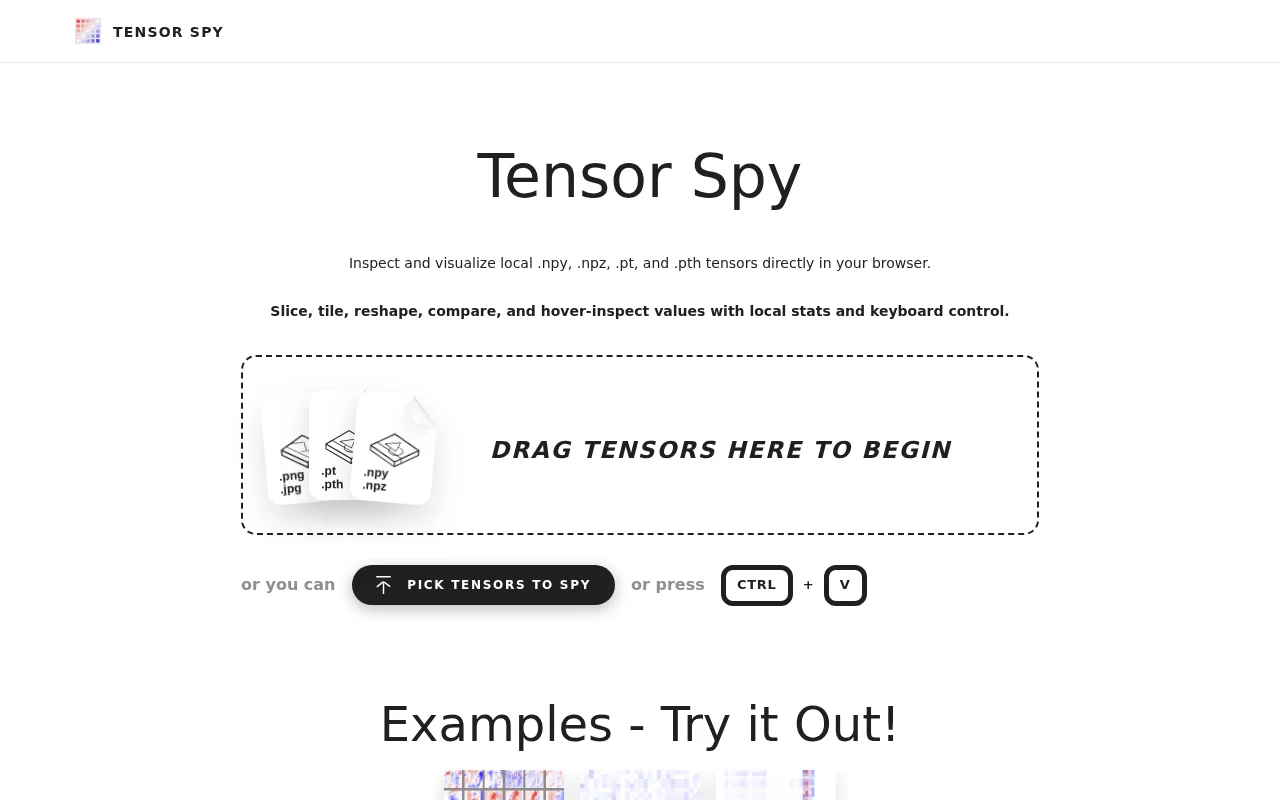
We needed a side project to give agentic coding a try, and created tensorspy.com together with Junie and ChatGPT 5.2.

Tensor Spy lets you quickly inspect the contents of numpy & pytorch tensors locally (your tensors are not uploaded to any servers).

This is useful to validate your deep learning data pipelines, to check which layers in your diverging model are actually going haywire, and just because it's kind of cool & a lot more convenient for one-off inspections than loading things up in python.

If you work with diffusion models, inspecting the latent space can be quite informative: you want some "noise" in there but it should probably be fairly smooth for your LDM (Latent Diffusion Model) to be able to target it well.

Also, if you haven't looked at your data, it's probably not what you think it is ;)

Basic stats are auto-computed, and any inf/nan values are both counted and rendered with contrasting colors, to help you quickly identify issue hotspots.

The site is free, and our broad intention is to keep it that way (we run a bunch of pro-bono little utility sites in addition to our commercial ones, they're all linked on the about page).

Would love to hear your thoughts, I'm sure there are some stats or utility features we missed, so please give it a spin and let us know!

---

Agentic coding is a brave new world. Three years ago, after the initial rush of ChatGPT's launch, I commented to some friends that "we're standing on the beach and the water just receded". The tsunami is really hitting now. As in: this project took about 2 weeks, and not only would we not have done it without agentic coding, it would have taken months using "traditional methods". With agentic coding, adding .pt/.pth support was basically a single request. And it just worked. Time to adapt yet again.
Similar Projects

AI/ML●●Solid

Macrograd – Micrograd, but with Tensors

Takes micrograd's toy autodiff idea and scales it to real tensor operations with NumPy and optional CuPy GPU support. The repo exposes an nn-like module, common activations (ReLU/Softmax), self-attention and an MNIST MLP example, so it's excellent as a learning resource. It's explicitly flagged as WIP — expect performance and OOM rough edges, so treat it as a study tool rather than a training backbone.

Niche GemShip It
polyrhachis
104mo ago