Productivity●Mid
Bangs – DuckDuckGo-style search shortcuts for Safari
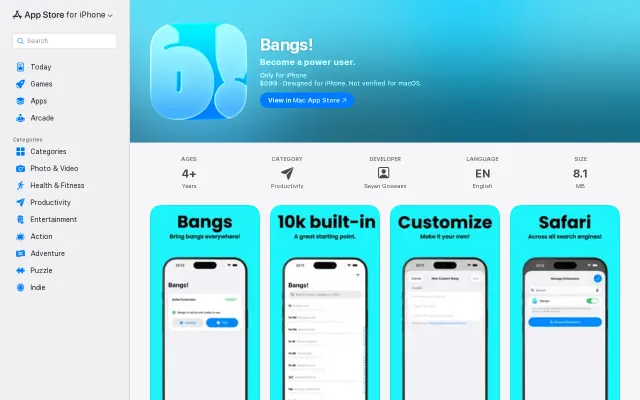
Local processing is nice but free Safari bang extensions already exist on the App Store.
CozySolve My Problem
metahost
112mo ago
Unduck done right: zero-deps, sub-1ms DuckDuckGo-style bang/snap redirector with 14,000+ DDG/Kagi/custom bangs, address bar autocomplete, no tracking.
Service Worker intercepts bangs before page load—measurably faster than every existing solution.
Power users, privacy-conscious searchers, folks who live in the address bar.
DuckDuckGo Bangs · Unduck · Kagi Bangs
Flashbang intercepts the request at the Service Worker level before the browser renders anything. The SW does a hashmap lookup and a string template fill on raw URL-encoded bytes. Median redirect latency is sub-1ms. The browser never loads a page.
How it works:
- Service Worker intercepts every search request before it becomes a navigation and before page starts loading
- Bang parsing operates on raw encoded strings — no decodeURIComponent, no regex, no new URL() in the hot path
- Supports all 7 DuckDuckGo bang syntax patterns (prefix, suffix, no-space, mid-query, etc.)
- 14,000+ bangs from DDG + Kagi, plus custom bangs
- Address bar autocomplete via OpenSearch with a radix trie, ranked by frecency (exponential decay, 14-day half-life)
- Once the SW is installed, redirects work fully offline
What it's not:
- Not a browser extension — it's a web app you set as your default search engine
- No tracking, no analytics, no telemetry
- Zero runtime dependencies
- AGPL-3.0
~2,600 lines of TypeScript, 1,200 lines of tests. I'd love feedback on the architecture.
Local processing is nice but free Safari bang extensions already exist on the App Store.
Sub-50ms Wikipedia reads using Cloudflare edge workers instead of heavy backend infrastructure.
Karpathy's microgpt in C99, proves tiny coordinated models beat single large models on logic.
You play a minimalist web game while a neural net trains in real time, so the opponent starts weak and adapts to your playstyle. The landing page is extremely spare — the demo is quick to load and oddly charming, but there’s little signposting about the model, implementation details, or source code. Fun as a curiosity or teaching toy, but not novel enough to wow ML folks who’ve seen in-browser learning demos before.
Blocks DNS rebinding and SSRF redirects where URL validation fails.
DNS TXT records as redirect config means no separate control panel to manage.