Developer Tools●●Solid

Onboard-CLI–a fast developer tool built in Go uses AST and LLM
AST density plus git history finds who actually owns each module, not just git blame.
Big BrainSlick
yr_animesh
2110d ago

Tree-sitter dependency graphs catch breaking changes before push, not after CI.
Backend and fullstack developers working in large codebases
Continue (IDE code understanding) · Sourcegraph Cody (dependency tracking) · IntelliJ built-in dependency viewer
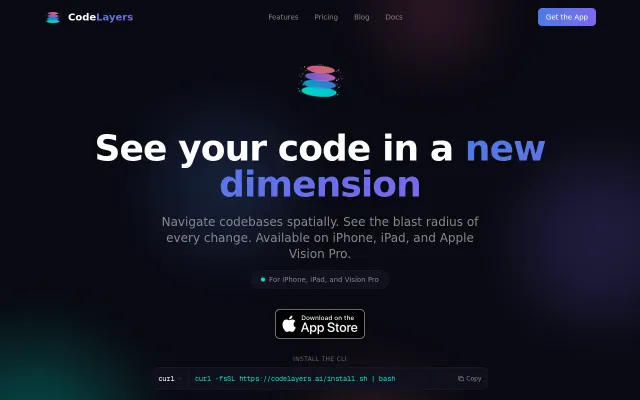
I wanted to see that before pushing, so I built this. It's a VS Code extension (works in Cursor too) that shows you which files are affected every time you save. The sidebar fills up with a tree of everything downstream, and the files get color coded by how far away they are from your change.
The part I actually use the most is the CodeLens — it shows caller counts above functions. If something shows zero callers, you know you can change it without worrying. Saves me from grep -r.
It's a Rust CLI underneath that uses tree-sitter to parse your code and build a dependency graph. Supports Rust, TypeScript, Python, Go, Java, and a few others (10 languages total). The CLI watches your repo and streams updates to the extension, usually under a second.
There's also a GitHub Action if you want blast radius comments on PRs automatically: https://github.com/codelayers-ai/codelayers-action
And you can try it without installing anything — paste a public GitHub URL here and it'll build a 3D dependency graph in the browser: https://codelayers.ai/explore
AST density plus git history finds who actually owns each module, not just git blame.
Deterministic AST parsing beats embeddings for code graph accuracy.
Deterministic Terraform risk scorer beats AI guessing for deploy safety.
Claims 95% fewer tokens than file-reading agents with git-diff-aware blast radius.
BFS-layered 3D codebase viz solves force-directed chaos; works in browser for instant PR review.
Graph theory metrics prioritize vulnerabilities better than CVSS scores alone.