AI/ML●●●Banger
Myco – coordinate Claude and DeepSeek and other LLMs in one agent swarm
Mycelium-style bus lets parallel Claude sessions share context without a central orchestrator.
Big BrainZero to One
cezarvil
2022d ago
Polywave Agent Skill for Claude Code: parallel AI agents with disjoint file ownership, worktree isolation, and human-reviewed plans. Requires polywave-tools CLI.
Multi-agent parallelism solved via markdown prompts, not framework magic—genuinely novel.
Software engineers using Claude Code, AI agent orchestration enthusiasts
The core idea: prevent conflicts at planning time through two invariants: 1. Disjoint file ownership: no two agents in the same wave touch the same file 2. Frozen interface contracts: agents code against exact type signatures defined upfront
How it works:
- Scout agent analyzes the codebase, runs a suitability gate (5 questions), produces a coordination artifact (IMPL doc) with file ownership table and interface contracts - Human reviews and approves - Scaffold agent creates shared type files from approved contracts, compiles them - Wave agents implement in parallel, each in its own git worktree - Orchestrator merges sequentially, conflict-free by construction
The interesting part: the entire protocol lives in natural language. Invariants are embedded verbatim in the prompts at their enforcement points. A capable LLM follows them consistently. This proves you can encode coordination protocols in prompts and get structural safety guarantees, which has implications beyond parallel coding.
Repo: https://github.com/blackwell-systems/scout-and-wave Formal spec with invariants I1-I6: https://github.com/blackwell-systems/scout-and-wave/blob/mai...
I built this because I kept spawning multiple Claude Code sessions in separate terminals and having them conflict. Worktrees isolated execution but didn't prevent the conflicts. Realized the missing piece was coordination before execution, not better infrastructure.
Tradeoffs: rigidity (if an interface is wrong mid-wave, you restart), LLM drift risk (prompts can be reasoned around, unlike code enforcement), and currently Claude Code specific (though the protocol is portable).
Dogfooded on 50+ features across multiple projects. Failure rate: suitability gate rejects ~20-30% of requests (correct rejections), ~85-90% of suitable decompositions complete on first try.
Mycelium-style bus lets parallel Claude sessions share context without a central orchestrator.
Schelling matching for AI agents, but needs real use case evidence.
Parallel agent teams with task dependencies—OpenCode's SDK made this possible before official support.
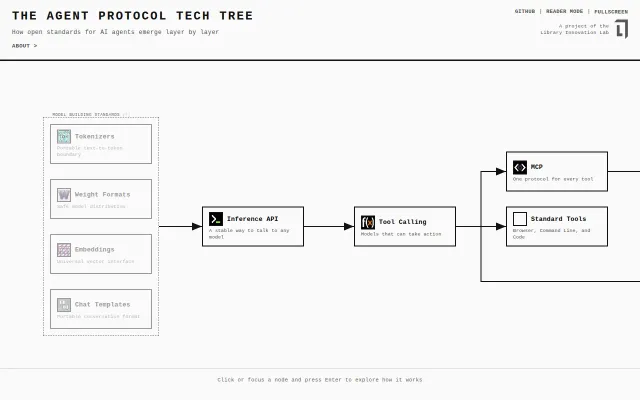
Civ-style tech tree for AI agent standards—good explainer, but presentation over substance.
Atomic task claims prevent race conditions when eight agents grab the same bug fix.
Shifts agents from tool operators to commitment coordinators with evidence settlement.